


Page 235 - English Lesson Plan Year 3
P. 235
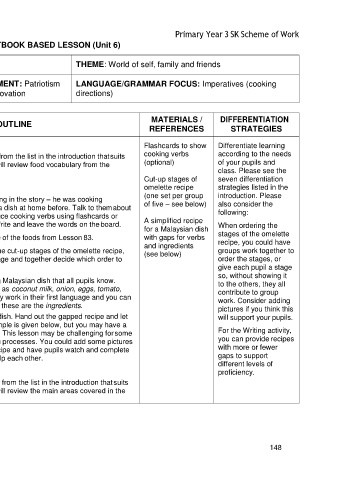
Primary Year 3 SK Scheme of Work
 SCHEME OF WORK: NON-TEXTBOOK BASED LESSON (Unit 6)

 LESSON: 84 (Writing 16)   MAIN SKILL FOCUS: Writing   THEME: World of self, family and friends
 WEEK:   TOPIC: Food, please!   CROSS-CURRICULAR ELEMENT: Patriotism   LANGUAGE/GRAMMAR FOCUS: Imperatives (cooking

                    directions)
 & Citizenship; Creativity & Innovation


 CONTENT   LEARNING                    MATERIALS /      DIFFERENTIATION
 STANDARD   STANDARD   LEARNING OUTLINE   REFERENCES      STRATEGIES

 Main Skill   Main Skill   Pre-lesson   Flashcards to show   Differentiate learning
 Writing 4.2   Writing 4.2.3   1.  Choose an appropriate pre-lesson activity from the list in the introduction that suits   cooking verbs   according to the needs
 Communicate   Give simple   your pupils’ needs and interests and that will review food vocabulary from the   (optional)   of your pupils and
 basic information   directions   previous lesson.      class. Please see the
 intelligibly for a      Lesson delivery   Cut-up stages of   seven differentiation
 range of purposes                   omelette recipe   strategies listed in the
                                                       introduction. Please
                                     (one set per group
 in print and digital   Complementary   2.  Ask pupils what the children’s dad was doing in the story – he was cooking
 media   Skill   omelettes. Ask pupils if they have cooked a dish at home before. Talk to them about   of five – see below)   also consider the
    Writing 4.3.2   cooking to find out what they know. Introduce cooking verbs using flashcards or      following:
 Complementary   Spell an increased   mime: break, cut up, mix, fry, stir, serve. Write and leave the words on the board.   A simplified recipe   When ordering the
 Skill   range of familiar           for a Malaysian dish   stages of the omelette
 Writing 4.3   high frequency   3.  Play a mime game using the verbs + some of the foods from Lesson 83.   with gaps for verbs   recipe, you could have
 Communicate with   words accurately in   4.  Pupils work in groups of five. Give pupils the cut-up stages of the omelette recipe,   and ingredients   groups work together to
 appropriate   guided writing   one stage each. They should read their stage and together decide which order to   (see below)   order the stages, or
 language form and   stand in.                         give each pupil a stage
 style for a range of                                  so, without showing it
 purposes in print   5.  Brainstorm together some ingredients for a Malaysian dish that all pupils know.   to the others, they all
 and digital media   Prepare some key words in advance, such as coconut milk, onion, eggs, tomato,   contribute to group
 potato, chicken, spices, rice etc. Pupils may work in their first language and you can   work. Consider adding
 supply the English translation. Explain that these are the ingredients.   pictures if you think this
 6.  Explain that pupils will write a recipe for a dish. Hand out the gapped recipe and let   will support your pupils.
 pupils work in pairs to complete it. An example is given below, but you may have a
 better or more appropriate recipe than this. This lesson may be challenging for some   For the Writing activity,
 pupils, who may be unfamiliar with cooking processes. You could add some pictures   you can provide recipes
 to the recipe or mime each stage of the recipe and have pupils watch and complete   with more or fewer
 the stage. Allow pupils to work with and help each other.   gaps to support
                                                       different levels of
 Post-lesson                                           proficiency.
 7.  Choose an appropriate post-lesson activity from the list in the introduction that suits
 your pupils’ needs and interests and that will review the main areas covered in the
 lesson.


                                                                    148

