


Page 49 - English Lesson Plan Year 3
P. 49
Primary Year 3 SK Scheme of Work
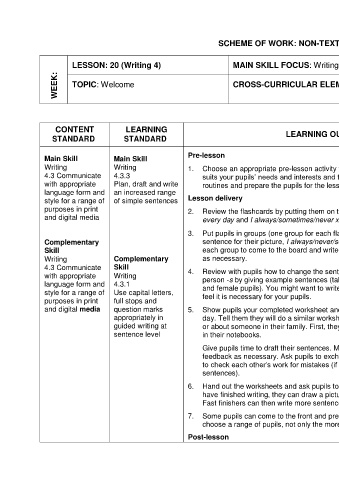
                                                       SCHEME OF WORK: NON-TEXTBOOK BASED LESSON (Unit 2)

                   LESSON: 20 (Writing 4)                  MAIN SKILL FOCUS: Writing                    THEME: World of Self, Family and Friends
               WEEK:   TOPIC: Welcome                      CROSS-CURRICULAR ELEMENT: Language           LANGUAGE/GRAMMAR FOCUS: Present simple for daily

                                                                                                        routines (third person He/She -s)


               CONTENT          LEARNING                                                                               MATERIALS /       DIFFERENTIATION
              STANDARD          STANDARD                                LEARNING OUTLINE                              REFERENCES            STRATEGIES
                                                Pre-lesson
            Main Skill       Main Skill                                                                               Flashcards for   Differentiate learning
            Writing          Writing            1.  Choose an appropriate pre-lesson activity from the list in the introduction that   daily routine   according to the needs of
            4.3 Communicate   4.3.3                suits your pupils’ needs and interests and that will review language related to   Worksheets, one   your pupils and class. Please
            with appropriate   Plan, draft and write   routines and prepare the pupils for the lesson.                per pupil + one   see the seven differentiation
            language form and  an increased range                                                                     completed by    strategies listed in the
            style for a range of   of simple sentences   Lesson delivery                                              you (see below)   introduction. Please also
            purposes in print                   2.  Review the flashcards by putting them on the board and eliciting sentences I xxx   consider the following:
            and digital media                      every day and I always/sometimes/never xxx from the pupils.        Ask pupils to   You can offer pupils the
                                                                                                                      bring a         choice of how many
                                                3.  Put pupils in groups (one group for each flashcard). Each group should draft a   toothbrush from   sentences to write, or ask
            Complementary                          sentence for their picture, I always/never/sometimes xxx. Ask one pupil from   home for the   them to write more/fewer than
            Skill                                  each group to come to the board and write their sentence. Supervise and assist   next lesson.   3–4.
            Writing          Complementary         as necessary.                                                      Bring a few extra
            4.3 Communicate   Skill             4.  Review with pupils how to change the sentence to He/She and adding the third   ones in case   Depending on the level of
            with appropriate   Writing             person -s by giving example sentences (talk about yourself and then about male   some pupils do   support your pupils need at
            language form and  4.3.1               and female pupils). You might want to write the sentences on the board if you   not bring their   this stage, you could keep /
            style for a range of   Use capital letters,   feel it is necessary for your pupils.                       own.            partially keep / delete the
            purposes in print   full stops and                                                                                        model sentences on the
            and digital media   question marks   5.  Show pupils your completed worksheet and talk to them about what you do every    board.
                             appropriately in      day. Tell them they will do a similar worksheet. They can write about themselves   If changing or having a choice
                             guided writing at     or about someone in their family. First, they should write three or four sentences   between 1 person (I) and 3 rd
                                                                                                                                              st
                             sentence level        in their notebooks.                                                                person (he/she) is too
                                                   Give pupils time to draft their sentences. Monitor carefully and give corrective   complicated for pupils, you
                                                                                                                                                  st
                                                   feedback as necessary. Ask pupils to exchange their notebooks with their partner   can limit it to 1  person only.
                                                   to check each other’s work for mistakes (if you could not check everybody’s
                                                   sentences).
                                                6.  Hand out the worksheets and ask pupils to write their sentences. When they
                                                   have finished writing, they can draw a picture in the larger boxes for each one.
                                                   Fast finishers can then write more sentences.
                                                7.  Some pupils can come to the front and present their work to the class. Try to
                                                   choose a range of pupils, not only the more proficient ones.
                                                Post-lesson
                                                                                                                                                         53

