


Page 40 - Social Impact
P. 40
POSITIVE IMPACT RATING 2022 NAMES IIMB The rating survey asked students 20 questions in seven relevant
AS ‘PIONEERING SCHOOL’ impact dimensions: governance and culture of the school;
study programmes, learning methods and student support;
IIMB has featured in the top category (Level 5) in the Positive the institution as a role model and its public engagement. The
Impact Rating (PIR) 2022, winning global recognition as ‘Pio- overall PIR score of the business school was used to position
neering School’. The institute has performed very well across all the schools across five levels. The different levels refer to the
seven dimensions, including governance, student support and levels of achievement in developing the social impact. Business
public engagement, measured in the survey. schools were provided with a defined social impact model and a
tool that they could then use for measuring their impact.
The Positive Impact Rating (PIR) is a rating conducted by
students and for students. For the third time, in 2022, students
worldwide assessed their business schools on how they perceive GREEN CAMPUS
their positive impact on the world. The positive impact of
business schools goes beyond their contribution to business and At IIMB, there is a strong focus on environmental awareness,
the economy; it addresses the need for their positive impact for positive impact and sustainable living. As part of the school’s
society. philosophy of ‘waste not, want not’, while food (wet) waste is
converted into biogas and compost, sorted dry waste is sent to
The PIR was created by business school experts together with authorized recyclers and thus IIMB is on the path to become a
global NGOs – WWF, Oxfam, and UN Global Compact. Inter- ‘zero-waste’ campus. Committed to the ‘zero-waste’ campaign,
national student associations oikos, AIESEC, and Net Impact 90 per cent of waste generated on campus is recycled and
partner with PIR, supported by VIVA Idea (Costa Rica), The reused.
Institute for Business Sustainability Foundation & Fehr Advice,
both from Switzerland. The students too, have a vibrant environment sustainability
club. Moreover, IIMB has incorporated sustainability in all its
Students from business schools located in five continents and courses.
21 countries participated in the survey. Despite the continued
COVID-19 crisis and its impact on campus education, the About 16.5% of the power requirement is met by roof-top solar
number of participating students, business schools and coun- plants. Energy-efficient equipment is used in all the buildings,
tries remained stable. hostels and classrooms, and across the campus. Battery-op-
CAMPUS, COMMUNITY & COMMITMENT erated electric vehicles and bicycles are used to commute on
The PIR 2022 edition featured 45 schools ranked at levels 3 or campus to reduce CO2 emissions. While 100% recycled water
TO SUSTAINABILITY higher. Four business schools – all from India – reached the top is used to maintain the award-winning gardens, 29% of runoff
Level 5 (pioneering schools). At Level 4 (transforming schools), water is recharged in the ground and 11.2% is stored to meet
IIM Bangalore, an institute renowned for offering world-class the PIR featured 29 schools, up from 24 schools last year. Level the annual water requirement.
3 (progressing schools) included 12 schools (18 last year).
management education, believes that delivering public good
is the best possible way to deliver lasting values. By infusing
social engagement and a sense of responsibility towards sus-
tainability among its students, the institute aims to build pub-
lic-minded leaders.
At IIMB, there is a strong focus on environmental awareness,
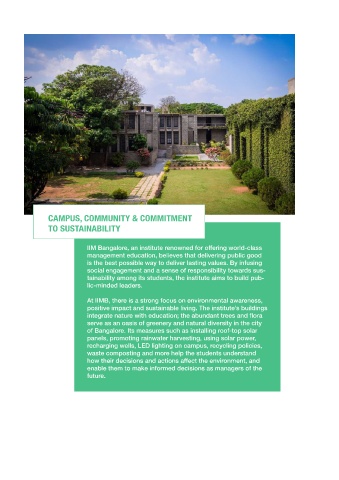
positive impact and sustainable living. The institute’s buildings
integrate nature with education; the abundant trees and flora
serve as an oasis of greenery and natural diversity in the city
of Bangalore. Its measures such as installing roof-top solar
panels, promoting rainwater harvesting, using solar power,
recharging wells, LED lighting on campus, recycling policies,
waste composting and more help the students understand
how their decisions and actions affect the environment, and
enable them to make informed decisions as managers of the
future.
Campus, Community and Commitment to Sustainability | 39

