


Page 285 - How to Make Money in Stocks Trilogy
P. 285
A = Annual Earnings Increases: Look for Big Growth 163


            Growth stocks with steady earnings tend to have a stability figure below 20
          or 25. Companies with stability ratings over 30 are more cyclical and a little
          less dependable in terms of their growth. All other things being equal, you
          may want to look for stocks showing a greater degree of sustainability, con-
          sistency, and stability in past earnings growth. Some companies that are
          growing 25% per year could have a stability rating of 1, 2, or 3. When the
          quarterly earnings for several years are plotted on a log-scale chart, the earn-
          ings line should be nearly straight, consistently moving up. In most cases
          there will be some acceleration in the rate of increase in recent quarters.


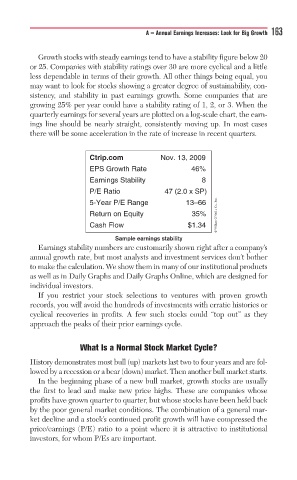
                          Ctrip.com          Nov. 13, 2009
                          EPS Growth Rate             46%
                          Earnings Stability             8
                          P/E Ratio           47 (2.0 x SP)
                                                             © William O’Neil + Co., Inc.
                          5-Year P/E Range          13–66
                          Return on Equity            35%
                          Cash Flow                  $1.34
                                 Sample earnings stability
            Earnings stability numbers are customarily shown right after a company’s
          annual growth rate, but most analysts and investment services don’t bother
          to make the calculation. We show them in many of our institutional products
          as well as in Daily Graphs and Daily Graphs Online, which are designed for
          individual investors.
            If you restrict your stock selections to ventures with proven growth
          records, you will avoid the hundreds of investments with erratic histories or
          cyclical recoveries in profits. A few such stocks could “top out” as they
          approach the peaks of their prior earnings cycle.


                       What Is a Normal Stock Market Cycle?
          History demonstrates most bull (up) markets last two to four years and are fol-
          lowed by a recession or a bear (down) market. Then another bull market starts.
            In the beginning phase of a new bull market, growth stocks are usually
          the first to lead and make new price highs. These are companies whose
          profits have grown quarter to quarter, but whose stocks have been held back
          by the poor general market conditions. The combination of a general mar-
          ket decline and a stock’s continued profit growth will have compressed the
          price/earnings (P/E) ratio to a point where it is attractive to institutional
          investors, for whom P/Es are important.

