


Page 519 - How to Make Money in Stocks Trilogy
P. 519
388  INVESTING LIKE A PROFESSIONAL


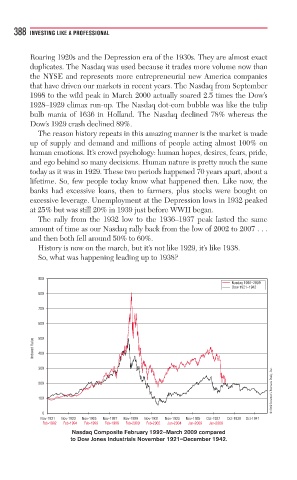
          Roaring 1920s and the Depression era of the 1930s. They are almost exact
          duplicates. The Nasdaq was used because it trades more volume now than
          the NYSE and represents more entrepreneurial new America companies
          that have driven our markets in recent years. The Nasdaq from September
          1998 to the wild peak in March 2000 actually soared 2.5 times the Dow’s
          1928–1929 climax run-up. The Nasdaq dot-com bubble was like the tulip
          bulb mania of 1636 in Holland. The Nasdaq declined 78% whereas the
          Dow’s 1929 crash declined 89%.
            The reason history repeats in this amazing manner is the market is made
          up of supply and demand and millions of people acting almost 100% on
          human emotions. It’s crowd psychology: human hopes, desires, fears, pride,
          and ego behind so many decisions. Human nature is pretty much the same
          today as it was in 1929. These two periods happened 70 years apart, about a
          lifetime. So, few people today know what happened then. Like now, the
          banks had excessive loans, then to farmers, plus stocks were bought on
          excessive leverage. Unemployment at the Depression lows in 1932 peaked
          at 25% but was still 20% in 1939 just before WWII began.
            The rally from the 1932 low to the 1936–1937 peak lasted the same
          amount of time as our Nasdaq rally back from the low of 2002 to 2007 . . .
          and then both fell around 50% to 60%.
            History is now on the march, but it’s not like 1929, it’s like 1938.
            So, what was happening leading up to 1938?


            900
                                                                 Nasdaq 1992–2009
                                                                 Dow 1921–1942
            800
            700

            600
           Indexed Value  500

            400
            300
                                                                            © 2009 Investor’s Business Daily, Inc.
            200
            100

             0
             Nov-1921  Nov-1923  Nov-1925  Nov-1927  Nov-1929  Nov-1931  Nov-1933  Nov-1935  Oct-1937  Oct-1939      Oct-1941
             Feb-1992  Feb-1994  Feb-1996  Feb-1998  Feb-2000  Feb-2002  Jan-2004  Jan-2006  Jan-2008
                     Nasdaq Composite February 1992–March 2009 compared
                     to Dow Jones Industrials November 1921–December 1942.

