


Page 215 - SK Year 5 Science DLP
P. 215
The pupil’s                                  The pupil’s
                                               view                                         view


                                                                                              o
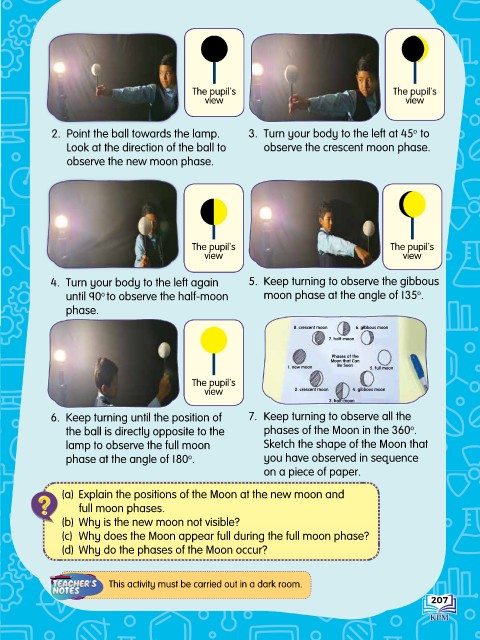
             2.  Point the ball towards the lamp.        3.  Turn your body to the left at 45 to
                Look at the direction of the ball to        observe the crescent moon phase.
                observe the new moon phase.


                                            The pupil’s                                  The pupil’s
                                               view                                         view


            4.  Turn your body to the left again         5.  Keep turning to observe the gibbous
                                                                                               o
                        o
                until 90 to observe the half-moon           moon phase at the angle of 135 .
                phase.
                                                                   8. crescent moon  6. gibbous moon
                                                                           7. half-moon

                                                                            Phases of the
                                                                           Moon that Can
                                                                  1. new moon  Be Seen  5. full moon
                                            The pupil’s
                                               view                2. crescent moon  4. gibbous moon
                                                                           3. half-moon
            6.  Keep turning until the position of       7.  Keep turning to observe all the
                                                                                             o
                the ball is directly opposite to the        phases of the Moon in the 360 .
                lamp to observe the full moon               Sketch the shape of the Moon that
                phase at the angle of 180 .                 you have observed in sequence
                                           o
                                                            on a piece of paper.

               (a)  Explain the positions of the Moon at the new moon and
                   full moon phases.
               (b)  Why is the new moon not visible?
               (c)  Why does the Moon appear full during the full moon phase?
               (d)  Why do the phases of the Moon occur?


             TEACHER'S    This activity must be carried out in a dark room.
             NOTE
                                                                                                  207207

