


Page 223 - SK Year 5 Science DLP
P. 223
MIND REFLECTION
                     MIND REFLECTION


             1.  The Moon does not emit its own light but reflects light from the Sun.

             2. The Moon rotates on its axis, anticlockwise for 27   days.

             3. The Moon revolves around the Earth, anticlockwise for 27   days.
             4. As the Moon revolves around the Earth, we will observe different parts of
               the Moon that are lit up by the sunlight.

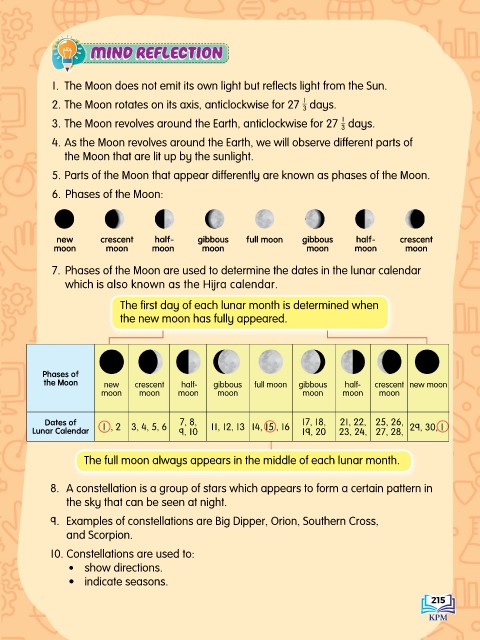
             5. Parts of the Moon that appear differently are known as phases of the Moon.

             6. Phases of the Moon:


              new       crescent    half-     gibbous   full moon     gibbous    half-     crescent
             moon        moon      moon       moon                      moon                      moon     moon

             7.  Phases of the Moon are used to determine the dates in the lunar calendar
                which is also known as the Hijra calendar.

                            The first day of each lunar month is determined when
                            the new moon has fully appeared.


           Phases of
           the Moon     new    crescent   half-  gibbous  full moon     gibbous  half-  crescent  new moon
                        moon    moon     moon     moon               moon                      moon   moon


           Dates of     1  , 2  3, 4, 5, 6  7, 8,  11, 12, 13 14, 15 , 16  17, 18,  21, 22, 25, 26,
        Lunar Calendar                   9, 10                       19, 20  23, 24, 27, 28,  29, 30, 1


                    The full moon always appears in the middle of each lunar month.


            8.  A constellation is a group of stars which appears to form a certain pattern in
                the sky that can be seen at night.
            9.  Examples of constellations are Big Dipper, Orion, Southern Cross,
                and Scorpion.

            10.  Constellations are used to:
                •   show directions.
                •   indicate seasons.

                                                                                                  215

