


Page 132 - English Download B1+
P. 132
Reading


        1   Make a list of the things you need electricity for. Which are the most
            important for you and which are the least important? Compare your
            answers as a class.


        2   Where does electricity come from? Match the types of power with
            the methods used to produce it.
            1  solar power                a  by capturing sunlight
            2  wind power                 b  by burning oil, coal or gas
            3  hydroelectric power        c  by splitting uranium atoms
            4  nuclear power              d  by using running or falling water
            5  fossil fuel power          e  by using the movement of the air
            6  geothermal power           f  by using steam from under the ground


        3  Read the text quickly. What is kinetic energy?


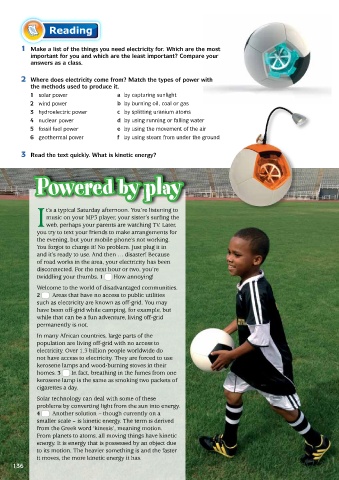
              Powered by play


                 t’s a typical Saturday afternoon. You’re listening to
                 music on your MP3 player, your sister’s surfing the
              Iweb, perhaps your parents are watching TV. Later,
              you try to text your friends to make arrangements for
              the evening, but your mobile phone’s not working.
              You forgot to charge it! No problem. Just plug it in
              and it’s ready to use. And then … disaster! Because
              of road works in the area, your electricity has been
              disconnected. For the next hour or two, you’re
              twiddling your thumbs. 1    How annoying!
              Welcome to the world of disadvantaged communities.
              2     Areas that have no access to public utilities
              such as electricity are known as off-grid. You may
              have been off-grid while camping, for example, but
              while that can be a fun adventure, living off-grid
              permanently is not.

              In many African countries, large parts of the
              population are living off-grid with no access to
              electricity. Over 1.3 billion people worldwide do
              not have access to electricity. They are forced to use
              kerosene lamps and wood-burning stoves in their
              homes. 3     In fact, breathing in the fumes from one
              kerosene lamp is the same as smoking two packets of
              cigarettes a day.

              Solar technology can deal with some of these
              problems by converting light from the sun into energy.
              4     Another solution – though currently on a
              smaller scale – is kinetic energy. The term is derived
              from the Greek word ‘kinesis’, meaning motion.
              From planets to atoms, all moving things have kinetic
              energy. It is energy that is possessed by an object due
              to its motion. The heavier something is and the faster
              it moves, the more kinetic energy it has.
      136

