


Page 54 - English Download B1+
P. 54
Reading


        1   Look at the list of environmental problems. Which ones are
            the most serious in your area/country?
              • acid rain    • destruction of forests    • drinking water quality
            • drought    • endangered species    • floods    • nuclear accidents
            • oil spills at sea    • polluted beaches    • smog


        2   Choose one of the problems from 1 and explain to a partner
            how it affects us and the planet we live on.


        3   Read the texts quickly. What do the people involved in the
            environmental projects all have in common?

        Teens Saving the Environment!


        Read about these amazing teenagers
        and their incredible ideas.


                A

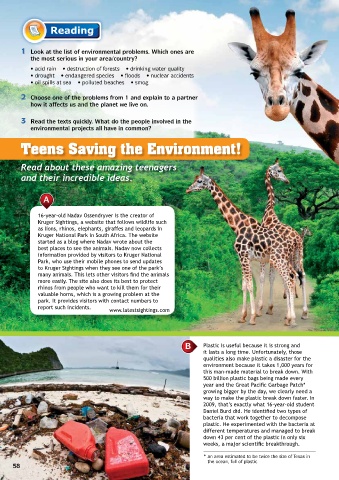
              16-year-old Nadav Ossendryver is the creator of
              Kruger Sightings, a website that follows wildlife such
              as lions, rhinos, elephants, giraffes and leopards in
              Kruger National Park in South Africa. The website
              started as a blog where Nadav wrote about the
              best places to see the animals. Nadav now collects
              information provided by visitors to Kruger National
              Park, who use their mobile phones to send updates
              to Kruger Sightings when they see one of the park’s
              many animals. This lets other visitors find the animals
              more easily. The site also does its best to protect
              rhinos from people who want to kill them for their
              valuable horns, which is a growing problem at the
              park. It provides visitors with contact numbers to
              report such incidents.
                                       www.latestsightings.com


                                                                  B     Plastic is useful because it is strong and
                                                                        it lasts a long time. Unfortunately, those
                                                                        qualities also make plastic a disaster for the
                                                                        environment because it takes 1,000 years for
                                                                        this man-made material to break down. With
                                                                        500 billion plastic bags being made every
                                                                        year and the Great Pacific Garbage Patch*
                                                                        growing bigger by the day, we clearly need a
                                                                        way to make the plastic break down faster. In
                                                                        2009, that’s exactly what 16-year-old student
                                                                        Daniel Burd did. He identified two types of
                                                                        bacteria that work together to decompose
                                                                        plastic. He experimented with the bacteria at
                                                                        different temperatures and managed to break
                                                                        down 43 per cent of the plastic in only six
                                                                        weeks, a major scientific breakthrough.
                                                                        *  an area estimated to be twice the size of Texas in
                                                                          the ocean, full of plastic
      58

