


Page 60 - English Download B1+
P. 60
Listening


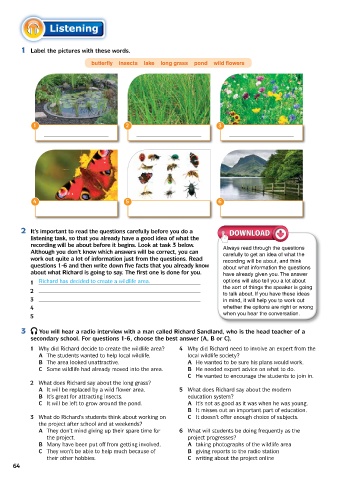
        1  Label the pictures with these words.

                                 butterfly    insects    lake    long grass    pond    wild flowers


             1                               2                                3


             4                               5                                6


        2   It’s important to read the questions carefully before you do a
            listening task, so that you already have a good idea of what the
            recording will be about before it begins. Look at task 3 below.    Always read through the questions
            Although you don’t know which answers will be correct, you can     carefully to get an idea of what the
            work out quite a lot of information just from the questions. Read   recording will be about, and think
            questions 1-6 and then write down five facts that you already know   about what information the questions
            about what Richard is going to say. The first one is done for you.  have already given you. The answer
            1  Richard has decided to create a wildlife area.                  options will also tell you a lot about
            2                                                                  the sort of things the speaker is going
                                                                               to talk about. If you have these ideas
            3                                                                  in mind, it will help you to work out
            4                                                                  whether the options are right or wrong
            5                                                                  when you hear the conversation.


        3     You will hear a radio interview with a man called Richard Sandland, who is the head teacher of a
            secondary school. For questions 1-6, choose the best answer (A, B or C).

            1   Why did Richard decide to create the wildlife area?    4    Why did Richard need to involve an expert from the
               A  The students wanted to help local wildlife.      local wildlife society?
               B  The area looked unattractive.                    A  He wanted to be sure his plans would work.
               C   Some wildlife had already moved into the area.       B  He needed expert advice on what to do.
                                                                   C   He wanted to encourage the students to join in.
            2   What does Richard say about the long grass?
               A  It will be replaced by a wild flower area.     5    What does Richard say about the modern
               B  It’s great for attracting insects.               education system?
               C   It will be left to grow around the pond.        A  It’s not as good as it was when he was young.
                                                                   B  It misses out an important part of education.
            3    What do Richard’s students think about working on       C   It doesn’t offer enough choice of subjects.
               the project after school and at weekends?
               A   They don’t mind giving up their spare time for      6    What will students be doing frequently as the
                 the project.                                      project progresses?
               B  Many have been put off from getting involved.       A  taking photographs of the wildlife area
               C    They won’t be able to help much because of        B  giving reports to the radio station
                 their other hobbies.                              C   writing about the project online
      64

