


Page 73 - English Download B1+
P. 73
Speaking


         1  Ask and answer the questions with a partner.
             •  Do you think crime is a problem where you live? What sort of crimes are committed?
             •  Have you ever witnessed or been a victim of a crime?
             •  How often do you see police officers? Are they on foot, in cars, on motorbikes or on horses?

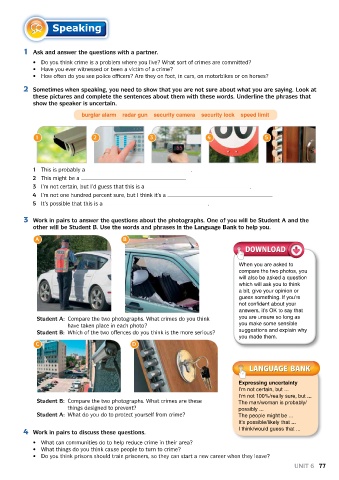
         2   Sometimes when speaking, you need to show that you are not sure about what you are saying. Look at
             these pictures and complete the sentences about them with these words. Underline the phrases that
             show the speaker is uncertain.
                              burglar alarm    radar gun    security camera    security lock    speed limit


              1                   2                   3                   4                   5


            1  This is probably a                                   .
            2  This might be a                                    .
            3  I’m not certain, but I’d guess that this is a                             .
            4  I’m not one hundred percent sure, but I think it’s a                             .
            5  It’s possible that this is a                               .


         3   Work in pairs to answer the questions about the photographs. One of you will be Student A and the
             other will be Student B. Use the words and phrases in the Language Bank to help you.

             A                              B


                                                                                     When you are asked to
                                                                                     compare the two photos, you
                                                                                     will also be asked a question
                                                                                     which will ask you to think
                                                                                     a bit, give your opinion or
                                                                                     guess something. If you’re
                                                                                     not confident about your
                                                                                     answers, it’s OK to say that
              Student A:   Compare the two photographs. What crimes do you think     you are unsure so long as
                         have taken place in each photo?                             you make some sensible
              Student B:  Which of the two offences do you think is the more serious?  suggestions and explain why
                                                                                     you made them.
              C                                D


                                                                                     Expressing uncertainty
                                                                                     I’m not certain, but ...
                                                                                     I’m not 100%/really sure, but ...
              Student B:   Compare the two photographs. What crimes are these        The man/woman is probably/
                         things designed to prevent?                                 possibly ...
              Student A:  What do you do to protect yourself from crime?             The people might be ...

                                                                                     It’s possible/likely that ...
                                                                                     I think/would guess that ...
         4  Work in pairs to discuss these questions.
             •  What can communities do to help reduce crime in their area?
             •  What things do you think cause people to turn to crime?
             •  Do you think prisons should train prisoners, so they can start a new career when they leave?
                                                                                                        UNIT 6   77

