


Page 104 - TCS ICT Book 8
P. 104
The City School  2021-2022


             5.3.  Raspberry Pi Architecture


             The Raspberry Pi has an ARM Architecture based Processor. With a high-speed

             processor and 1 GB RAM, the PI can be used for many demanding projects like digital
             image processing and many IoT and connected projects. The Raspberry Pi also

             consists of a set of pins that allow it to communicate with other nearby electronic
             devices.


             General purpose input-output (GPIO)


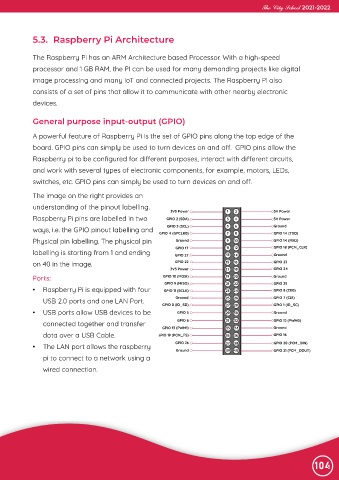
             A powerful feature of Raspberry Pi is the set of GPIO pins along the top edge of the
             board. GPIO pins can simply be used to turn devices on and off.  GPIO pins allow the

             Raspberry pi to be configured for different purposes, interact with different circuits,
             and work with several types of electronic components, for example, motors, LEDs,

             switches, etc. GPIO pins can simply be used to turn devices on and off.

             The image on the right provides an
             understanding of the pinout labelling.
                                                             3V3 Power           1  2            5V Power
             Raspberry Pi pins are labelled in two         GPIO 2 (SDA)          3  4            5V Power
             ways, i.e. the GPIO pinout labelling and       GPIO 3 (SCL)         5  6            Ground
                                                         GPIO 4 (GPCLK0)         7  8            GPIO 14 (TXD)
             Physical pin labelling. The physical pin          Ground            9  10           GPIO 14 (RXD)
                                                               GPIO 17           11  12          GPIO 18 (PCM_CLK)
             labelling is starting from 1 and ending          GPIO 27           13  14           Ground
             on 40 in the image.                              GPIO 22           15  16           GPIO 23
                                                             3V3 Power          17  18           GPIO 24
             Ports:                                       GPIO 10 (MOSI)        19  20           Ground
                                                           GPIO 9 (MISO)        21  22           GPIO 25
             •  Raspberry Pi is equipped with four         GPIO 11 (SCLK)       23  24           GPIO 8 (CE0)
                USB 2.0 ports and one LAN Port.                Ground           25  26           GPIO 7 (CE1)
                                                          GPIO 0 (ID_SD)        27  28           GPIO 1 (ID_SC)
             •  USB ports allow USB devices to be              GPIO 5           29  30           Ground

                connected together and transfer                GPIO 6           31  32           GPIO 12 (PWM0)
                                                          GPIO 13 (PWM1)        33  34           Ground
                data over a USB Cable.                  GPIO 19 (PCM_FS)        35  36           GPIO 16

             •  The LAN port allows the raspberry              GPIO 26          37  38           GPIO 20 (PCM_DIN)
                                                               Ground           39  40           GPIO 21 (PCM_DOUT)
                pi to connect to a network using a

                wired connection.


                                                                                                                104

