


Page 85 - TCS ICT Book 7
P. 85
The City School  2021-2022


             3.7.  Data and Network Security


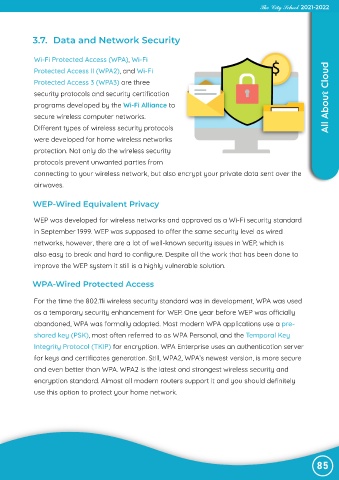
             Wi-Fi Protected Access (WPA), Wi-Fi
             Protected Access II (WPA2), and Wi-Fi                                              $

             Protected Access 3 (WPA3) are three
             security protocols and security certification                                                          All About Cloud

             programs developed by the Wi-Fi Alliance to
             secure wireless computer networks.

             Different types of wireless security protocols
             were developed for home wireless networks

             protection. Not only do the wireless security
             protocols prevent unwanted parties from

             connecting to your wireless network, but also encrypt your private data sent over the
             airwaves.


             WEP-Wired Equivalent Privacy

             WEP was developed for wireless networks and approved as a Wi-Fi security standard

             in September 1999. WEP was supposed to offer the same security level as wired
             networks, however, there are a lot of well-known security issues in WEP, which is

             also easy to break and hard to configure. Despite all the work that has been done to
             improve the WEP system it still is a highly vulnerable solution.


            WPA-Wired Protected Access


             For the time the 802.11i wireless security standard was in development, WPA was used
             as a temporary security enhancement for WEP. One year before WEP was officially

             abandoned, WPA was formally adopted. Most modern WPA applications use a pre-
             shared key (PSK), most often referred to as WPA Personal, and the Temporal Key

             Integrity Protocol (TKIP) for encryption. WPA Enterprise uses an authentication server
             for keys and certificates generation. Still, WPA2, WPA’s newest version, is more secure

             and even better than WPA. WPA2 is the latest and strongest wireless security and
             encryption standard. Almost all modern routers support it and you should definitely

             use this option to protect your home network.


                                                                                                                85

