


Page 21 - Tennis Magazine April 2019
P. 21
The story begins in June 1999, when       family from Japan to New York,              competition, but for me, every day was
                 Leonard François, a native of Haiti         where he once lived. Like the               a competition. Every day I’d say, ‘I’m
                 living in Japan, caught a glimpse of        Williamses in Compton, CA, François,        going to beat you tomorrow.’”
                 two young sisters, Venus and Serena         Mari and Naomi began to train on the           Twelve years later, Naomi got her
                 Williams, on their way to winning the       public courts of Long Island.               win. By then, the Osakas had headed
                 French Open doubles. François wasn’t          The resemblances between the              south to Pembroke Pines, FL, where
                 a tennis player, but he wondered if he      families didn’t stop there. In both         the girls were home-schooled as they
                 could replicate what Richard Williams       cases, it was the older sister who was      continued their tennis regimen. Naomi
                                                                                assumed to be the        largely skipped the juniors, just as the
                                                                                future star; in both     Williamses had, and turned pro at 14.
                 She’s a global citizen with                                    cases, it was the           Yet unlike Venus and Serena, who
                                                                                younger sister who       were pre-teen celebrities, Osaka’s
                 roots in multiple cultures                                     willed herself to        potential went largely unrecognized

                 and a personality that                                         surpass her. As          by tennis scouts in the U.S. François
                                                                                a child, Serena          decided that his daughters would
                 refl ects aspects of each.                                      thought of Venus         represent their native Japan instead.
                                                                                as a “fierce swan,”
                                                                                and herself as the          Whatever flag she plays for, Osaka is
                 had done. François and his Japanese         family’s “ugly duckling.” For Naomi,        an example of a phenomenon familiar
                 wife, Tamaki Osaka, had two daughters       the dynamic was less metaphoric, and        to tennis: she’s a global citizen with
                 of their own: Mari, 3, and Naomi, 1.        more straightforwardly zero-sum.            roots in multiple cultures—in her case,
                   Many parents have tried to emulate          “I don’t remember liking to hit the       Haitian, Japanese and American—and
                 the success of the Williams family, but     ball,” Osaka told The New York Times.       a personality that’s hard to pigeonhole.
                 François was especially committed to        “The main thing was I wanted to                Some days she can play the part
                 the dream. The next year, he moved his      beat my sister. For her, it wasn’t a        of a young Serena: fist-pumping,
                                                                                                         emoting and letting her majestic hair
                                                                                                         fly. On other days, negative emotions
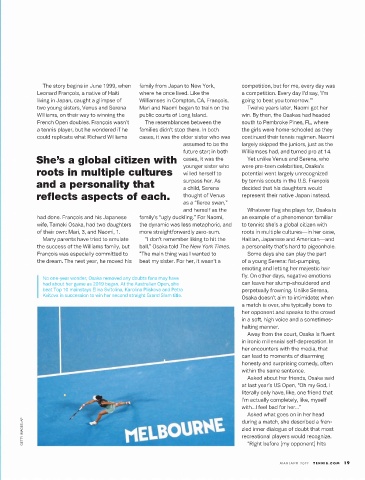
                   No one-year wonder, Osaka removed any doubts fans may have
                   had about her game as 2019 began. At the Australian Open, she                         can leave her slump-shouldered and
                   beat Top 10 mainstays Elina Svitolina, Karolina Pliskova and Petra                    perpetually frowning. Unlike Serena,
                   Kvitova in succession to win her second straight Grand Slam title.
                                                                                                         Osaka doesn’t aim to intimidate; when
                                                                                                         a match is over, she typically bows to
                                                                                                         her opponent and speaks to the crowd
                                                                                                         in a soft, high voice and a sometimes-
                                                                                                         halting manner.
                                                                                                            Away from the court, Osaka is fluent
                                                                                                         in ironic millennial self-deprecation. In
                                                                                                         her encounters with the media, that
                                                                                                         can lead to moments of disarming
                                                                                                         honesty and surprising comedy, often
                                                                                                         within the same sentence.
                                                                                                            Asked about her friends, Osaka said
                                                                                                         at last year’s US Open, “Oh my God, I
                                                                                                         literally only have, like, one friend that
                                                                                                         I’m actually completely, like, myself
                                                                                                         with...I feel bad for her...”
                                                                                                            Asked what goes on in her head
           GETTY IMAGES; AP                                                                              zied inner dialogue of doubt that most
                                                                                                         during a match, she described a fren-

                                                                                                         recreational players would recognize.
                                                                                                            “Right before [my opponent] hits


                                                                                                                         M A R / A P R  2 0 1 9  T E N N I S . C O M  1 9

