


Page 64 - Tennis Magazine April 2019
P. 64
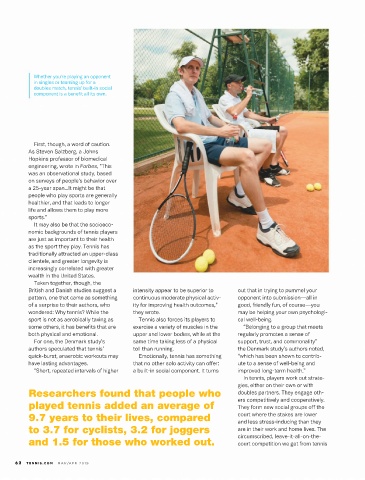
Whether you’re playing an opponent
                in singles or teaming up for a
                doubles match, tennis’ built-in social
                component is a benefit all its own.


                First, though, a word of caution.
             As Steven Salzberg, a Johns
             Hopkins professor of biomedical
             engineering, wrote in Forbes, “This
             was an observational study, based
             on surveys of people’s behavior over
             a 25-year span...It might be that
             people who play sports are generally
             healthier, and that leads to longer
             life and allows them to play more
             sports.”
                It may also be that the socioeco-
             nomic backgrounds of tennis players
             are just as important to their health
             as the sport they play. Tennis has
             traditionally attracted an upper-class
             clientele, and greater longevity is
             increasingly correlated with greater
             wealth in the United States.
                Taken together, though, the
             British and Danish studies suggest a         intensity appear to be superior to           out that in trying to pummel your
             pattern, one that came as something          continuous moderate physical activ-          opponent into submission—all in
             of a surprise to their authors, who          ity for improving health outcomes,”          good, friendly fun, of course—you
             wondered: Why tennis? While the              they wrote.                                  may be helping your own psychologi-
             sport is not as aerobically taxing as           Tennis also forces its players to         cal well-being.
             some others, it has benefits that are        exercise a variety of muscles in the            “Belonging to a group that meets
             both physical and emotional.                 upper and lower bodies, while at the         regularly promotes a sense of
                For one, the Denmark study’s              same time taking less of a physical          support, trust, and commonality”
             authors speculated that tennis’              toll than running.                           the Denmark study’s authors noted,
             quick-burst, anaerobic workouts may             Emotionally, tennis has something         “which has been shown to contrib-
             have lasting advantages.                     that no other solo activity can offer:       ute to a sense of well-being and
                “Short, repeated intervals of higher      a built-in social component. It turns        improved long-term health.”
                                                                                                          In tennis, players work out strate-
                                                                                                       gies, either on their own or with
             Researchers found that people who                                                         doubles partners. They engage oth-

                                                                                                       ers competitively and cooperatively.
             played tennis added an average of                                                         They form new social groups off the

             9.7 years to their lives, compared                                                        court where the stakes are lower
                                                                                                       and less stress-inducing than they
             to 3.7 for cyclists, 3.2 for joggers                                                      are in their work and home lives. The
                                                                                                       circumscribed, leave-it-all-on-the-
             and 1.5 for those who worked out.                                                         court competition we get from tennis


        6 2  T E N N I S . C O M  M A R /A P R  2 0 1 9

