


Page 37 - SP015 Past Years PSPM Chapter 6 -14 Ver 2020
P. 37
PSPM SP015


                     PSPM 2012/2013  SF016/2  No. 6(b)

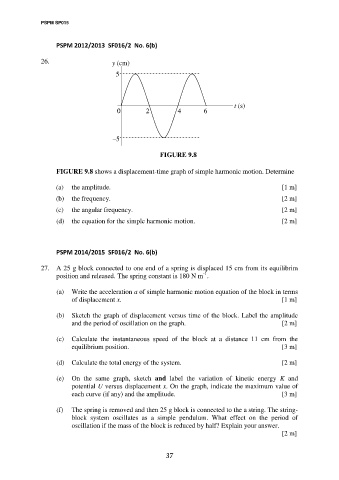
               26.                      y (cm)

                                          5


                                          0         2          4         6         t (s)


                                         –5

                                                         FIGURE 9.8

                     FIGURE 9.8 shows a displacement-time graph of simple harmonic motion. Determine

                     (a)  the amplitude.                                                            [1 m]

                     (b)  the frequency.                                                            [2 m]
                     (c)  the angular frequency.                                                    [2 m]

                     (d)  the equation for the simple harmonic motion.                              [2 m]


                     PSPM 2014/2015  SF016/2  No. 6(b)

               27.  A 25 g block connected to one end of a spring is displaced 15 cm from its equilibrim
                                                                        -1
                     position and released. The spring constant is 180 N m .

                     (a)  Write the acceleration a of simple harmonic motion equation of the block in terms
                          of displacement x.                                                        [1 m]

                     (b)  Sketch the graph of displacement versus time of the block. Label the amplitude
                          and the period of oscillation on the graph.                               [2 m]

                     (c)  Calculate  the  instantaneous  speed  of  the  block  at  a  distance  11  cm  from  the
                          equilibrium position.                                                     [3 m]

                     (d)  Calculate the total energy of the system.                                 [2 m]

                     (e)  On  the  same  graph,  sketch  and  label  the  variation  of  kinetic  energy  K  and
                          potential U versus displacement x. On the graph, indicate the maximum value of
                          each curve (if any) and the amplitude.                                    [3 m]

                     (f)  The spring is removed and then 25 g block is connected to the a string. The string-
                          block  system  oscillates  as  a  simple  pendulum.  What  effect  on  the  period  of
                          oscillation if the mass of the block is reduced by half? Explain your answer.
                                                                                                    [2 m]


                                                           37

