Page 81 - SP015 Past Years PSPM Chapter 6 -14 Ver 2020
P. 81
PSPM SP015


                                                            -1
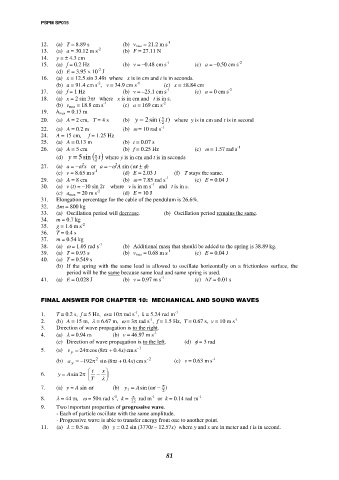
               12.   (a)  T = 8.89 s        (b)  v max  = 21.2 m s
                                   -2
               13.   (a)  a = 30.12 m s     (b)  F = 27.11 N
               14.   y =  4.3 cm
                                                            -1
                                                                                     -2
               15.   (a)  f = 0.2 Hz        (b)  v = –0.48 cm s      (c)  a = –0.50 cm s
                                   -2
                     (d)  E = 3.95  10  J
               16.   (a)  x = 12.5 sin 3.49t  where   x is in cm and t is in seconds.
                                                 -1
                                   -2
                     (b)  a = 91.4 cm s ,   v = 34.9 cm s     (c)  x = 8.84 cm
                                                            -1
                                                                                 -2
               17.   (a)  f = 1 Hz          (b)  v = –25.1 cm s      (c)  a = 0 cm s
               18.   (a)  x = 2 sin 3t   where   x is in cm and   t is in s.
                                                          -2
                                     -1
                     (b)  v max  = 18.8 cm s     (c)  a = 169 cm s
               19.   h max  = 0.13 m
               20.   (a)  A = 2 cm,   T = 4 s   (b)  y     2 sin  (  2  ) t   where  y is in cm and t is in second
                                                          -1
               22.   (a)  A = 0.2 m         (b)    = 10 rad s
               24.   A = 15 cm,     f = 1.25 Hz
               25.   (a)  A = 0.13 m        (b)  t = 0.07 s
                                                                                    -1
               26.   (a)  A = 5 cm          (b)  f = 0.25 Hz         (c)    = 1.57 rad s
                     (d)  y     5 sin    t  where y is in cm and t is in seconds
                                  
                                  2
                              2
                                          2
               27.   (a)  a = – x   or   a = – A sin ( t   )
                                  -1
                     (c)  v = 8.65 m s      (d)  E = 2.03 J   (f)  T stays the same.
                                                           -1
               29.   (a)  A = 8 cm          (b)    = 7.85 rad s     (c)  E = 0.04 J
                                                      -1
               30.   (a)  v (t) = –10 sin 2t    where   v is in m s    and   t is in s.
                                   -2
                     (c)  a max  = 20 m s     (d)  E = 10 J
               31.   Elongation percentage for the cable of the pendulum is 26.6%.
               32.   m = 800 kg
               33.   (a)  Oscillation period will decrease.   (b)  Oscillation period remains the same.
               34.   m = 0.7 kg
                              -2
               35.   g = 1.6 m s
               36.   T = 0.4 s
               37.   m = 0.54 kg
                                    -1
               38.   (a)    = 1.05 rad s    (b)  Additional mass that should be added to the spring is 38.89 kg.
                                                            -1
               39.   (a)  T = 0.93 s        (b)  v max  = 0.68 m s    (c)  E = 0.04 J
               40.   (a)  T = 0.549 s
                     (b)  If  the  spring  with  the  same  load  is  allowed  to  oscillate  horizontally  on  a  frictionless  surface,  the
                        period will be the same because same load and same spring is used.
                                                          -1
               41.   (a)  E = 0.028 J       (b)  v = 0.97 m s        (c)  T = 0.01 s


               FINAL ANSWER FOR CHAPTER 10:  MECHANICAL AND SOUND WAVES

                                                              -1
                                                -1
               1.    T = 0.2 s,  f = 5 Hz,    = 10 rad s ,  k = 5.24 rad m
                                                      -1
                                                                                   -1
               2.    (b)  A = 15 m,    = 6.67 m,    = 3 rad s ,  f = 1.5 Hz,  T = 0.67 s,  v = 10 m s
               3.    Direction of wave propagation is to the right.
                                                       -1
               4.    (a)    = 0.94 m    (b)  v = 46.97 m s
                     (c)  Direction of wave propagation is to the left.   (d)    = 3 rad
                                     
               5.    (a)  v   24   cos   (8 t   0.4x    ) cm s    -1
                          y
                                                                            -1
                     (b)  a    192    sin  (8 t   0.4x    ) cm s    -2     (c)  v = 0.63 m s
                                        
                          y
                                 t  x  
               6.    y   Asin  2        

                                 T   
               7.    (a)  y = A sin  t   (b)  y 1      A sin  (t     2 )
                                                
                                         -1
                                                                       -1
                                                      -1
               8.      = 44 m,     = 50 rad s ,  k =   22   rad m   or  k = 0.14 rad m
               9.    Two important properties of progressive wave.
                     - Each of particle oscillate with the same amplitude.
                     - Progressive wave is able to transfer energy from one to another point.
               11.   (a)    = 0.5 m   (b)  y = 0.2 sin (3770t – 12.57x)  where y and x are in meter and t is in second.
                                                           81
   76   77   78   79   80   81   82   83   84   85   86