


Page 245 - Programming With Python 3
P. 245
An Introduction to STEM Programming with Python — 2019-09-03a                              Page 232
            Bonus Chapter 3 — The Math Module

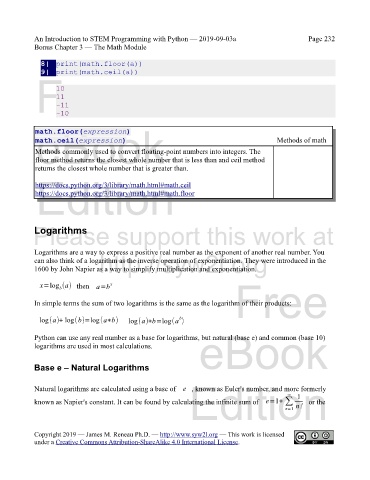
               8|  print(math.floor(a))
               9|  print(math.ceil(a))
             Free

                    10
                    11
                    -11
                    -10
             eBook
             math.floor(expression)
             math.ceil(expression)                                                           Methods of math
             Methods commonly used to convert floating-point numbers into integers. The
             floor method returns the closest whole number that is less than and ceil method
             returns the closest whole number that is greater than.
             Edition
             https://docs.python.org/3/library/math.html#math.ceil
             https://docs.python.org/3/library/math.html#math.floor


            Please support this work at
            Logarithms


            Logarithms are a way to express a positive real number as the exponent of another real number. You
                                  http://syw2l.org
            can also think of a logarithm as the inverse operation of exponentiation. They were introduced in the
            1600 by John Napier as a way to simplify multiplication and exponentiation.
                                                                               Free
              x=log (a) then  a=b     x
                     b

            In simple terms the sum of two logarithms is the same as the logarithm of their products:

                                                            b
              log(a)+ log(b)=log(a∗b)       log(a)∗b=log(a )

            Python can use any real number as a base for logarithms, but natural (base e) and common (base 10)
            logarithms are used in most calculations.              eBook


            Base e – Natural Logarithms

                                                                Edition
            Natural logarithms are calculated using a base of  e , known as Euler's number, and more formerly
                                                                                                ∞
                                                                                                   1
                                                                                               ∑
            known as Napier's constant. It can be found by calculating the infinite sum of  e=1+  n=1  n!  or the


            Copyright 2019 — James M. Reneau Ph.D. — http://www.syw2l.org — This work is licensed
            under a Creative Commons Attribution-ShareAlike 4.0 International License.

