


Page 63 - Programming With Python 3
P. 63
An Introduction to STEM Programming with Python — 2019-09-03a                               Page 50
            Chapter 4 — Collections of Data

                       "Sneezy", "Dopey" ]
               2|  print(dwarfs)
             Free
               3|  print(dwarfs[1])
               4|  dwarfs[6] = "Bubba"
               5|  print(dwarfs)


                    ['Doc', 'Grumpy', 'Happy', 'Sleepy', 'Bashful', 'Sneezy',
                    'Dopey']
             eBook
                    Grumpy
                    ['Doc', 'Grumpy', 'Happy', 'Sleepy', 'Bashful', 'Sneezy',
                    'Bubba']


             Edition
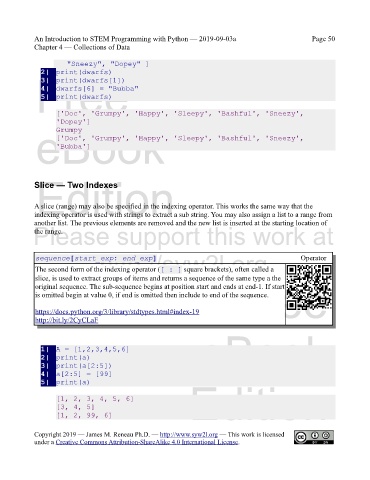
            Slice — Two Indexes


            A slice (range) may also be specified in the indexing operator. This works the same way that the
            indexing operator is used with strings to extract a sub string. You may also assign a list to a range from
            another list. The previous elements are removed and the new list is inserted at the starting location of
            Please support this work at
            the range.


                                  http://syw2l.org
             sequence[start_exp: end_exp]                                                            Operator
             The second form of the indexing operator ([ : ] square brackets), often called a
             slice, is used to extract groups of items and returns a sequence of the same type a the
                                                                               Free
             original sequence. The sub-sequence begins at position start and ends at end-1. If start
             is omitted begin at value 0, if end is omitted then include to end of the sequence.

             https://docs.python.org/3/library/stdtypes.html#index-19
             http://bit.ly/2CyCLaF


               1|  A = [1,2,3,4,5,6]                               eBook
               2|  print(a)
               3|  print(a[2:5])
               4|  a[2:5] = [99]
               5|  print(a)

                    [1, 2, 3, 4, 5, 6]                          Edition
                    [3, 4, 5]
                    [1, 2, 99, 6]


            Copyright 2019 — James M. Reneau Ph.D. — http://www.syw2l.org — This work is licensed
            under a Creative Commons Attribution-ShareAlike 4.0 International License.

