


Page 70 - Programming With Python 3
P. 70
An Introduction to STEM Programming with Python — 2019-09-03a                               Page 57
            Chapter 4 — Collections of Data


                    [1, 3, 4, 6, 99]
             Free
                    ['baz', 'buz', 'zap', 'zip']


            The Dictionary

             eBook
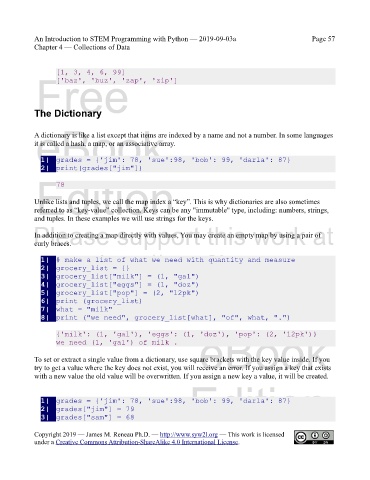
            A dictionary is like a list except that items are indexed by a name and not a number. In some languages
            it is called a hash, a map, or an associative array.

               1|  grades = {'jim': 78, 'sue':98, 'bob': 99, 'darla': 87}
               2|  print(grades["jim"])
             Edition
                    78


            Unlike lists and tuples, we call the map index a “key”. This is why dictionaries are also sometimes
            referred to as “key-value” collection. Keys can be any "immutable" type, including: numbers, strings,
            and tuples. In these examples we will use strings for the keys.
            Please support this work at
            In addition to creating a map directly with values, You may create an empty map by using a pair of
            curly braces.

                                  http://syw2l.org
               1|  # make a list of what we need with quantity and measure
               2|  grocery_list = {}
               3|  grocery_list["milk"] = (1, "gal")
               4|  grocery_list["eggs"] = (1, "doz")
               5|  grocery_list["pop"] = (2, "12pk")
               6|  print (grocery_list)                                        Free
               7|  what = "milk"
               8|  print ("we need", grocery_list[what], "of", what, ".")

                    {'milk': (1, 'gal'), 'eggs': (1, 'doz'), 'pop': (2, '12pk')}
                    we need (1, 'gal') of milk .                   eBook

            To set or extract a single value from a dictionary, use square brackets with the key value inside. If you
            try to get a value where the key does not exist, you will receive an error. If you assign a key that exists
            with a new value the old value will be overwritten. If you assign a new key a value, it will be created.
                                                                Edition


               1|  grades = {'jim': 78, 'sue':98, 'bob': 99, 'darla': 87}
               2|  grades["jim"] = 79
               3|  grades["sam"] = 68


            Copyright 2019 — James M. Reneau Ph.D. — http://www.syw2l.org — This work is licensed
            under a Creative Commons Attribution-ShareAlike 4.0 International License.

