


Page 78 - Programming With Python 3
P. 78
An Introduction to STEM Programming with Python — 2019-09-03a                               Page 65
            Chapter 5 — For (Looping)

            For with Range

             Free
            The range() function creates a sequence of integers. We can use this sequence with a for statement
            to repeat a block of code a certain number of times. There are three different ways to specify a range: 1)
            specifying the length of the range (starting at 0); 2) specifying the start and end values of a range; and
            3) specifying the start, end, and step size.

             eBook

             range(length_expr)
             range(start_expr, stop_expr)
             range(start_expr, stop_expr, step_expr)                                                Sequence
             The range object creates a read only sequence of integers that is typically used with
             the for statement to loop a specific number of times. There are three general ways to
             Edition
             use range:

             1) with a single integer that created a range starting at 0 up to length-1.
             2) with start and stop that will create a range of integers from start to stop -1.
             3) with start, stop, and step that will create a range of integers incremented by step
             from start to stop-step.
            Please support this work at
             https://docs.python.org/3/library/stdtypes.html#range
             http://bit.ly/2AfWTNk
                                  http://syw2l.org


                NOTE: In Python range parameters must be integers.
                                                                               Free

            Range with length


            range(end)
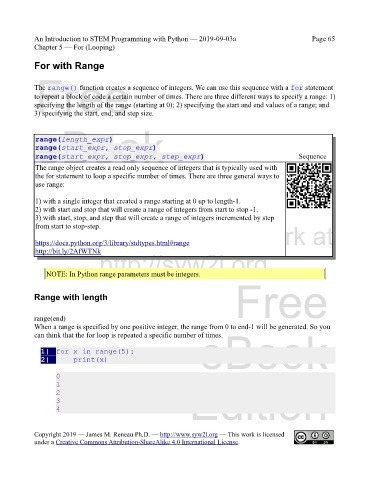
            When a range is specified by one positive integer, the range from 0 to end-1 will be generated. So you
            can think that the for loop is repeated a specific number of times.


               1|  for x in range(5):                              eBook
               2|      print(x)


                    0
                    1
                    2
                    3                                           Edition
                    4


            Copyright 2019 — James M. Reneau Ph.D. — http://www.syw2l.org — This work is licensed
            under a Creative Commons Attribution-ShareAlike 4.0 International License.

