


Page 88 - Programming With Python 3
P. 88
An Introduction to STEM Programming with Python — 2019-09-03a                               Page 75
            Chapter 6 — Boolean


             and  or  not                                                                  Boolean Operators
             Free
             The symbols and, or and not are used as the Boolean operators. Values
             evaluated by the operators do not need to be strictly Boolean.

             X or Y — if X is false then Y else X
             X and Y — if X is false then X else Y
             not X — if X is false then True else False
             eBook

             https://docs.python.org/3/reference/expressions.html#boolean-operations
             http://bit.ly/2Re0MwF


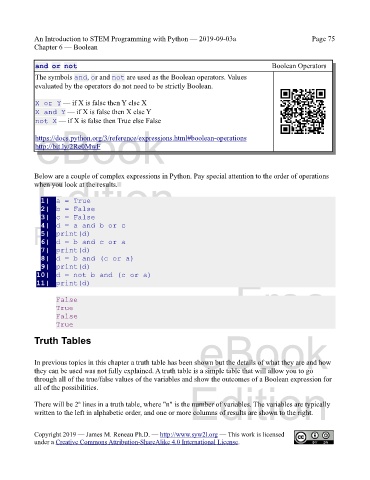
            Below are a couple of complex expressions in Python. Pay special attention to the order of operations
             Edition
            when you look at the results.

               1|  a = True
               2|  b = False
               3|  c = False
               4|  d = a and b or c
            Please support this work at
               5|  print(d)
               6|  d = b and c or a
               7|  print(d)
                                  http://syw2l.org
               8|  d = b and (c or a)
               9|  print(d)
             10|  d = not b and (c or a)
             11|  print(d)

                    False                                                      Free
                    True
                    False
                    True
                                                                   eBook
            Truth Tables


            In previous topics in this chapter a truth table has been shown but the details of what they are and how
            they can be used was not fully explained. A truth table is a simple table that will allow you to go
            through all of the true/false values of the variables and show the outcomes of a Boolean expression for
                                                                Edition
            all of the possibilities.

                           n
            There will be 2  lines in a truth table, where "n" is the number of variables. The variables are typically
            written to the left in alphabetic order, and one or more columns of results are shown to the right.


            Copyright 2019 — James M. Reneau Ph.D. — http://www.syw2l.org — This work is licensed
            under a Creative Commons Attribution-ShareAlike 4.0 International License.

