


Page 467 - รวมไฟล์วารสาร ปีที่ 8 ฉบับที่ 1
P. 467
inclined to use the frequency of one times per week, the less they agree that the longer the
               consumers with high economic risk spend on Alipay.
                          Finally, we use frequency and time as dependent variables, perceive ease of use,
               perceive  usefulness,  perceive  risk  and  use  scenario  as  independent  variables  to  conduct
               disorderly multinomial logistic regression analysis.
                          In terms of usage frequency, we can see that the higher the consumer's recognition
               of ease of use, the more likely it is to use frequency more than 7 times a week. The more likely
               it is to use more than 7 times a week, the more worried about economic risks, the less frequent
               it will be used. In terms of usage time, the higher the recognition degree of ease of use, the
               greater the possibility that the usage time is longer than one year, and the shorter the usage time
               with economic risk, while perceived usefulness has little effect on the usage time.
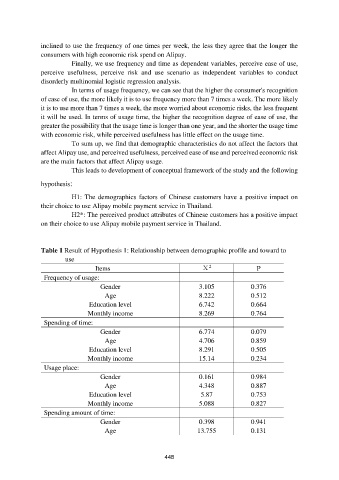
                          To sum up, we find that demographic characteristics do not affect the factors that
               affect Alipay use, and perceived usefulness, perceived ease of use and perceived economic risk
               are the main factors that affect Alipay usage.
                          This leads to development of conceptual framework of the study and the following


               hypothesis:
                          H1: The demographics factors of Chinese customers have a  positive impact  on
               their choice to use Alipay mobile payment service in Thailand.
                          H2*: The perceived product attributes of Chinese customers has a positive impact
               on their choice to use Alipay mobile payment service in Thailand.


               Table 1 Result of Hypothesis 1: Relationship between demographic profile and toward to
                        use
                                                                          2
                                  Items                                 Χ                  P
                Frequency of usage:
                                    Gender                             3.105             0.376
                                      Age                              8.222             0.512
                                Education level                        6.742             0.664
                                Monthly income                         8.269             0.764
                Spending of time:
                                    Gender                             6.774             0.079
                                      Age                              4.706             0.859
                                Education level                        8.291             0.505
                                Monthly income                         15.14             0.234
                Usage place:
                                    Gender                             0.161             0.984
                                      Age                              4.348             0.887
                                Education level                         5.87             0.753
                                Monthly income                         5.088             0.827
                Spending amount of time:
                                    Gender                             0.398             0.941
                                      Age                             13.755             0.131


                                                           448

