


Page 497 - รวมไฟล์วารสาร ปีที่ 8 ฉบับที่ 1
P. 497
Research Methodology

                         This  research  study  discussed  the  relationship  between  demographic  profile,
               perceived benefit, integrated marketing communication (IMC tools) and purchasing intention
               of  Cambodian  consumers  on  healthcare  services  in  Thailand  according  to  the  following
               constructs:

                         1.  Demographic  profile:  gender,  age,  marital  status,  income  range  (annual),
               Occupation, education, and city/province of resident
                         2.  Perceived benefit: emotional benefit and functional benefit
                         3.  Integrated  marketing  communication  (IMC  tools):  online  channel  and  offline
               channel
                         4.  Purchasing intention: expectation in treatment and cost of treatment

                         This  research study  aims to  collect  data  from  the Cambodian patients  who visit
               hospital in Thailand in order to receive medical check-up and treatment. There are 5 hospitals
               in Bangkok, Thailand which are selected to conduct the study. Those include Bangkok hospital,
               Phyathai 1 hospital, Phyathai 2 hospital, Phyathai 3 hospital, and Bumrongrad hospital. Due to
               the limitation of the study, the researcher collected need to specify the limited number of the
               respondents to collect data and analyze the data. Therefore,  the researcher considered 100
               respondents at minimum as a sample size.

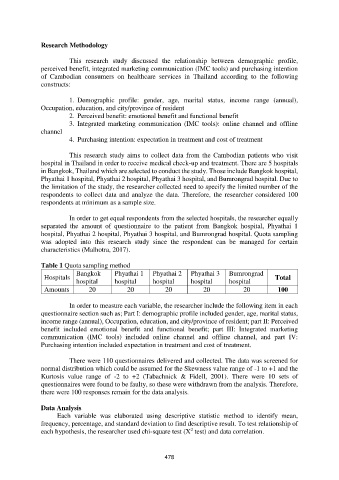
                         In order to get equal respondents from the selected hospitals, the researcher equally
               separated  the  amount  of  questionnaire  to  the  patient  from  Bangkok  hospital,  Phyathai  1
               hospital, Phyathai 2 hospital, Phyathai 3 hospital, and Bumrongrad hospital. Quota sampling
               was  adopted  into  this  research  study  since  the  respondent  can  be  managed  for  certain
               characteristics (Malhotra, 2017).

               Table 1 Quota sampling method
                            Bangkok      Phyathai 1    Phyathai 2   Phyathai 3   Bumrongrad
                 Hospitals                                                                        Total
                            hospital     hospital      hospital     hospital     hospital
                 Amounts        20            20           20           20            20           100

                         In order to measure each variable, the researcher include the following item in each
               questionnaire section such as; Part I: demographic profile included gender, age, marital status,
               income range (annual), Occupation, education, and city/province of resident; part II: Perceived
               benefit  included  emotional  benefit  and  functional  benefit;  part  III:  Integrated  marketing
               communication  (IMC  tools)  included  online  channel  and  offline  channel,  and  part  IV:
               Purchasing intention included expectation in treatment and cost of treatment.

                         There were 110 questionnaires delivered and collected. The data was screened for
               normal distribution which could be assumed for the Skewness value range of -1 to +1 and the
               Kurtosis  value  range  of  -2  to  +2  (Tabachnick  &  Fidell,  2001).  There  were  10  sets  of
               questionnaires were found to be faulty, so these were withdrawn from the analysis. Therefore,
               there were 100 responses remain for the data analysis.

               Data Analysis
                     Each  variable  was  elaborated  using  descriptive  statistic  method  to  identify  mean,
               frequency, percentage, and standard deviation to find descriptive result. To test relationship of
                                                                    2
               each hypothesis, the researcher used chi-square test (X  test) and data correlation.


                                                           478

