


Page 62 - Unit2.docx
P. 62
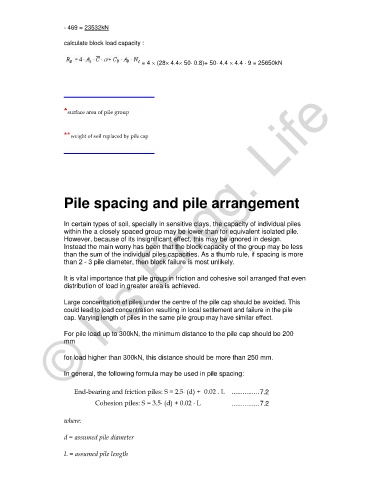
- 469 = 23532kN

                      calculate block load capacity :

                                                = 4 × (28× 4.4× 50⋅ 0.8)+ 50⋅ 4.4 × 4.4 ⋅ 9 = 25650kN


                      © It's Engg. Life


                      ♣  surface area of pile group


                      ♣♣
                         weight of soil replaced by pile cap


                      Pile spacing and pile arrangement


                      In certain types of soil, specially in sensitive clays, the capacity of individual piles
                      within the a closely spaced group may be lower than for equivalent isolated pile.
                      However, because of its insignificant effect, this may be ignored in design.
                      Instead the main worry has been that the block capacity of the group may be less
                      than the sum of the individual piles capacities. As a thumb rule, if spacing is more
                      than 2 - 3 pile diameter, then block failure is most unlikely.

                      It is vital importance that pile group in friction and cohesive soil arranged that even
                      distribution of load in greater area is achieved.

                      Large concentration of piles under the centre of the pile cap should be avoided. This
                      could lead to load concentration resulting in local settlement and failure in the pile
                      cap. Varying length of piles in the same pile group may have similar effect.

                      For pile load up to 300kN, the minimum distance to the pile cap should be 200
                      mm

                      for load higher than 300kN, this distance should be more than 250 mm.

                      In general, the following formula may be used in pile spacing:

                          End-bearing and friction piles: S = 2.5⋅ (d) +  0.02 . L    ...............  7.2
                                Cohesion piles: S = 3.5⋅ (d) + 0.02 ⋅ L       ............... 7.2

                      where:

                      d = assumed pile diameter

                      L = assumed pile length

