


Page 37 - ssr_16
P. 37
1.1.6. To what extent does the College use the guidelines of the regulatory bodies
for developing or restructuring the curricula? Has the College been instrumental
in leading any curricular reform which has created a national impact?
The College strictly adheres to guidelines laid down by the UGC and the
University for developing and restructuring the curricula. The most recent example of
this adherence is the phased manner in which CBCS courses were introduced after a
due process of planning at the postgraduate and undergraduate levels in the academic
year 2016-17. This is in tune with the national plan of providing choice based
education to students.
The successful introduction of two industry-integrated courses namely B. Com -
BPS and M. Sc. Big Data Analytics has proved that even colleges of liberal education
such as ours can offer industry-integrated courses and may be a model for other
colleges to follow, thus creating a national impact. Both the courses have components
in the disciplines which the College already has namely Computer Science,
Mathematics, Statistics and Economics but has incorporated the industry component
from TCS.
In both the courses, study material, teacher training and resources have been provided
by TCS. The infrastructure and resources, including a state-of-the art laboratory for
the M. Sc. Program, have been provided by TCS under its Corporate Social
Responsibility program. Students of both courses will intern with the industry and
placement opportunity will also be provided by the industry.
1.2. ACADEMIC FLEXIBILITY
The period following autonomy has been characterized by many learning experiences
in making courses optimally flexible in the interests of student learning.
1.2.1. Give details on the following provisions with reference to academic
flexibility
a. Core/Elective options
The College offers undergraduate programs ranging from general degree programs
(B.A. and B.Sc.) in the three-major format stipulated by Bangalore University, to
professional degree programs, namely, Bachelor in Computer Applications (BCA),
B.A. (Visual Communication), B. Com., and Bachelor in Social Work (BSW). The
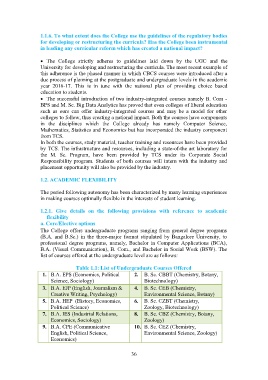
list of courses offered at the undergraduate level are as follows:
Table 1.1: List of Undergraduate Courses Offered
1. B.A. EPS (Economics, Political 2. B. Sc. CBBT (Chemistry, Botany,
Science, Sociology) Biotechnology)
3. B.A. EJP (English, Journalism & 4. B. Sc. CEB (Chemistry,
Creative Writing, Psychology) Environmental Science, Botany)
5. B.A. HEP (History, Economics, 6. B. Sc. CZBT (Chemistry,
Political Science) Zoology, Biotechnology)
7. B.A. IES (Industrial Relations, 8. B. Sc. CBZ (Chemistry, Botany,
Economics, Sociology) Zoology)
9. B.A. CPE (Communicative 10. B. Sc. CEZ (Chemistry,
English, Political Science, Environmental Science, Zoology)
Economics)
36

