


Page 96 - Health & Physical edu- 8
P. 96
which we can practice slowly or fast at our convenience. But practising this exercise
              quickly by unhealthy people could be dangerous. It helps to make nervous system
              and circulatory system active. It refreshes our mind and improves concentration. It
              cures diseases such as common cold, cough, asthma, allergy, etc.

              Steps for Bhastrika

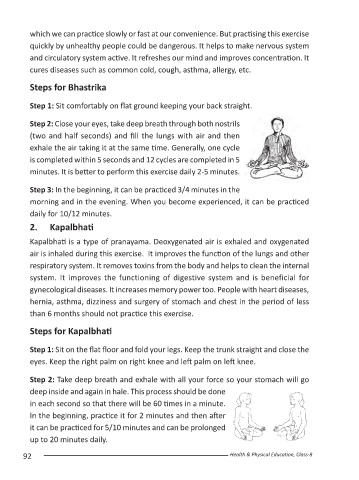
              Step 1: Sit comfortably on flat ground keeping your back straight.


              Step 2: Close your eyes, take deep breath through both nostrils
              (two and half seconds) and fill the lungs with air and then
              exhale the air taking it at the same time. Generally, one cycle
              is completed within 5 seconds and 12 cycles are completed in 5
              minutes. It is better to perform this exercise daily 2-5 minutes.

              Step 3: In the beginning, it can be practiced 3/4 minutes in the
              morning and in the evening. When you become experienced, it can be practiced

              daily for 10/12 minutes.
              2.   Kapalbhati
              Kapalbhati is a type of pranayama. Deoxygenated air is exhaled and oxygenated

              air is inhaled during this exercise.  It improves the function of the lungs and other
              respiratory system. It removes toxins from the body and helps to clean the internal
              system. It improves the functioning of digestive system and is beneficial for
              gynecological diseases. It increases memory power too. People with heart diseases,
              hernia, asthma, dizziness and surgery of stomach and chest in the period of less
              than 6 months should not practice this exercise.

              Steps for Kapalbhati


              Step 1: Sit on the flat floor and fold your legs. Keep the trunk straight and close the
              eyes. Keep the right palm on right knee and left palm on left knee.

              Step 2: Take deep breath and exhale with all your force so your stomach will go
              deep inside and again in hale. This process should be done
              in each second so that there will be 60 times in a minute.
              In the beginning, practice it for 2 minutes and then after
              it can be practiced for 5/10 minutes and can be prolonged

              up to 20 minutes daily.
            92                                                         Health & Physical Education, Class-8

