


Page 160 - Health, Population and Environment Education 9
P. 160
7.1  Concept of Environmental Health

          The word ‘environment’ has been derived from two
          French words: ‘environ’ and ‘ment’. The meaning of
          ‘environ’ in French is wind circuit and ‘ment’ is action
          or result. The literal meaning of environment is the
          whole area covered with air.
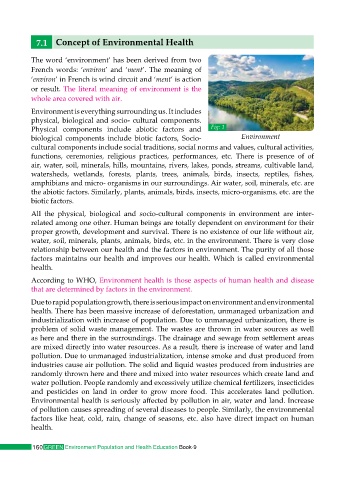
          Environment is everything surrounding us. It includes
          physical, biological and socio- cultural components.
          Physical components include abiotic factors and     Fig: 1
          biological components include biotic factors, Socio-         Environment
          cultural components include social traditions, social norms and values, cultural activities,
          functions, ceremonies,  religious practices, performances, etc. There is presence of of
          air, water, soil, minerals, hills, mountains, rivers, lakes, ponds, streams, cultivable land,
          watersheds,  wetlands,  forests,  plants,  trees,  animals,  birds,  insects,  reptiles,  fishes,
          amphibians and micro- organisms in our surroundings. Air water, soil, minerals, etc. are
          the abiotic factors. Similarly, plants, animals, birds, insects, micro-organisms, etc. are the
          biotic factors.
          All  the physical,  biological  and  socio-cultural  components in  environment  are  inter-
          related among one other. Human beings are totally dependent on environment for their
          proper growth, development and survival. There is no existence of our life without air,
          water, soil, minerals, plants, animals, birds, etc. in the environment. There is very close
          relationship between our health and the factors in environment. The purity of all those
          factors maintains our health and improves our health. Which is called environmental
          health.
          According to WHO, Environment health is those aspects of human health and disease
          that are determined by factors in the environment.
          Due to rapid population growth, there is serious impact on environment and environmental
          health. There has been massive increase of deforestation, unmanaged urbanization and
          industrialization with increase of population. Due to unmanaged urbanization, there is
          problem of solid waste management. The wastes are thrown in water sources as well
          as here and there in the surroundings. The drainage and sewage from settlement areas
          are mixed directly into water resources. As a result, there is increase of water and land
          pollution. Due to unmanaged industrialization, intense smoke and dust produced from
          industries cause air pollution. The solid and liquid wastes produced from industries are
          randomly thrown here and there and mixed into water resources which create land and
          water pollution. People randomly and excessively utilize chemical fertilizers, insecticides
          and pesticides  on land in order  to grow more  food.  This  accelerates land pollution.
          Environmental health is seriously affected by pollution in air, water and land. Increase
          of pollution causes spreading of several diseases to people. Similarly, the environmental
          factors like heat, cold, rain, change of seasons, etc. also have direct impact on human
          health.

          160  GREEN Environment Population and Health Education Book-9

