


Page 245 - 9 teachers social book 9 @ 2077 ctp_Neat
P. 245
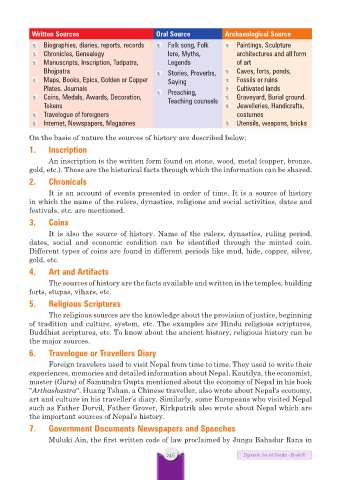
Written Sources                     Oral Source         Archaeological Source
              Biographies, diaries, reports, records    Folk song, Folk     Paintings, Sculpture
              Chronicles, Genealogy               lore, Myths,        architectures and all form
              Manuscripts, Inscription, Tadpatra,   Legends           of art
              Bhojpatra                           Stories, Proverbs,     Caves, forts, ponds,
              Maps, Books, Epics, Golden or Copper   Saying           Fossils or ruins
              Plates. Journals                    Preaching,          Cultivated lands
              Coins, Medals, Awards, Decoration,   Teaching counsels    Graveyard, Burial ground.
              Tokens                                                  Jewelleries, Handicrafts,
              Travelogue of foreigners                                costumes
              Internet, Newspapers, Magazines                         Utensils, weapons, bricks
          On the basis of nature the sources of history are described below:
          1.   Inscription

               An inscription is the written form found on stone, wood, metal (copper, bronze,
          gold, etc.). These are the historical facts through which the information can be shared.
          2.   Chronicals
               It is an account of events presented in order of time. It is a source of history
          in which the name of the rulers, dynasties, religions and social activities, dates and
          festivals, etc. are mentioned.
          3.   Coins

               It is also the source of history. Name of the rulers, dynasties, ruling period,
          dates,  social  and  economic  condition  can  be  identified  through  the  minted  coin.
          Different types of coins are found in different periods like mud, hide, copper, silver,
          gold, etc.
          4.   Art and Artifacts

               The sources of history are the facts available and written in the temples, building
          forts, stupas, vihars, etc.
          5.   Religious Scriptures

               The religious sources are the knowledge about the provision of justice, beginning
          of tradition and culture, system, etc. The examples are Hindu religious scriptures,
          Buddhist scriptures, etc. To know about the ancient history, religious history can be
          the major sources.
          6.   Travelogue or Travellers Diary

               Foreign travelers used to visit Nepal from time to time. They used to write their
          experiences, memories and detailed information about Nepal. Kautilya, the economist,
          master (Guru) of Samundra Gupta mentioned about the economy of Nepal in his book
          "Arthashastra". Huang Tshan, a Chinese traveller, also wrote about Nepal's economy,
          art and culture in his traveller’s diary. Similarly, some Europeans who visited Nepal
          such as Father Dorvil, Father Grover, Kirkpatrik also wrote about Nepal which are
          the important sources of Nepal’s history.
          7.   Government Documents Newspapers and Speeches
               Muluki Ain, the first written code of law proclaimed by Junga Bahadur Rana in

                                                 245                    Dynamic Social Studies - Book IX

