


Page 100 - Interchange English 5
P. 100
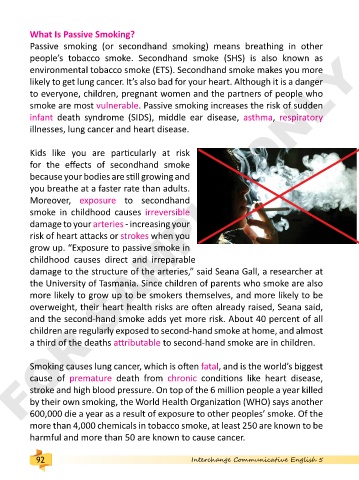
What Is Passive Smoking?
          Passive  smoking  (or  secondhand  smoking)  means  breathing  in  other
      FOR SAMPLE ONLY
          people’s  tobacco  smoke.  Secondhand  smoke  (SHS)  is  also  known  as
          environmental tobacco smoke (ETS). Secondhand smoke makes you more
          likely to get lung cancer. It’s also bad for your heart. Although it is a danger

          to everyone, children, pregnant women and the partners of people who
          smoke are most vulnerable. Passive smoking increases the risk of sudden
          infant  death  syndrome  (SIDS),  middle  ear  disease,  asthma,  respiratory
          illnesses, lung cancer and heart disease.


          Kids  like  you  are  particularly  at  risk
          for  the  effects  of  secondhand  smoke
          because your bodies are still growing and
          you breathe at a faster rate than adults.
          Moreover,  exposure to secondhand
          smoke  in  childhood  causes  irreversible
          damage to your arteries - increasing your

          risk of heart attacks or strokes when you
          grow up. “Exposure to passive smoke in
          childhood  causes  direct  and  irreparable
          damage to the structure of the arteries,” said Seana Gall, a researcher at
          the University of Tasmania. Since children of parents who smoke are also
          more likely to grow up to be smokers themselves, and more likely to be
          overweight, their heart health risks are often already raised, Seana said,
          and the second-hand smoke adds yet more risk. About 40 percent of all

          children are regularly exposed to second-hand smoke at home, and almost
          a third of the deaths attributable to second-hand smoke are in children.


          Smoking causes lung cancer, which is often fatal, and is the world’s biggest
          cause  of  premature  death  from  chronic  conditions  like  heart  disease,
          stroke and high blood pressure. On top of the 6 million people a year killed
          by their own smoking, the World Health Organization (WHO) says another
          600,000 die a year as a result of exposure to other peoples’ smoke. Of the
          more than 4,000 chemicals in tobacco smoke, at least 250 are known to be
          harmful and more than 50 are known to cause cancer.


           92                                          Interchange Communicative English 5

