


Page 129 - Interchange English 5
P. 129
In 1952, Mandela became one of the ANC’s deputy presidents. By the late
           1950s,  faced  with  increasing  government  discrimination,  Mandela,  his
      FOR SAMPLE ONLY
           friend Oliver Tambo and others began to move the ANC in a more radical
           direction. In 1956, Mandela went on trial for treason. The court case lasted
           five years, and ended with Mandela being acquitted.


           Sharpeville
           In  March  1960,  69  black  anti-apartheid  demonstrators  were  killed  by
           police  at  Sharpeville.  The  government  declared  a  state  of  emergency
           and banned the ANC. In response, the organisation abandoned its policy
           of  non-violence and  Mandela  helped  establish  the  ANC’s  military  wing
           ‘Umkhonto we Sizwe’ or ‘The Spear of the Nation’. He was appointed its
           commander-in-chief and travelled abroad to receive military training and
           to find support for the ANC.


           Life imprisonment
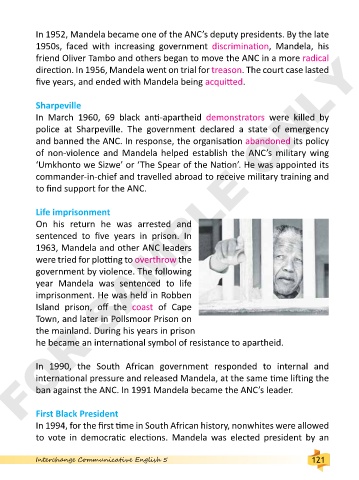
           On  his  return  he  was  arrested  and

           sentenced  to  five  years  in  prison.  In
           1963, Mandela and other ANC leaders
           were tried for plotting to overthrow the
           government by violence. The following
           year  Mandela  was  sentenced  to  life
           imprisonment. He was held in Robben
           Island  prison,  off  the  coast  of  Cape
           Town, and later in Pollsmoor Prison on

           the mainland. During his years in prison
           he became an international symbol of resistance to apartheid.


           In  1990,  the  South  African  government  responded  to  internal  and
           international pressure and released Mandela, at the same time lifting the
           ban against the ANC. In 1991 Mandela became the ANC’s leader.


           First Black President
           In 1994, for the first time in South African history, nonwhites were allowed
           to  vote  in  democratic  elections.  Mandela  was  elected  president  by  an


           Interchange Communicative English 5                                            121

