


Page 159 - Social Studies 7
P. 159
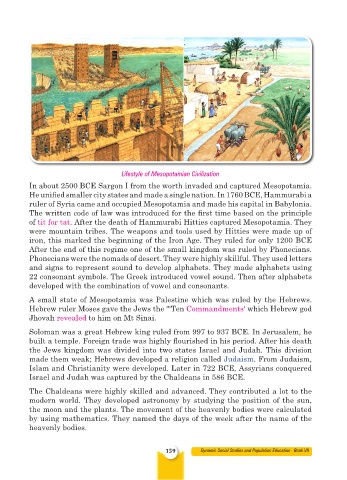
Lifestyle of Mesopotamian Civilization
          In about 2500 BCE Sargon I from the worth invaded and captured Mesopotamia.
          He unified smaller city states and made a single nation. In 1760 BCE, Hammurabi a
          ruler of Syria came and occupied Mesopotamia and made his capital in Babylonia.
          The written code of law was introduced for the first time based on the principle
          of tit for tat. After the death of Hammurabi Hitties captured Mesopotamia. They
          were mountain tribes. The weapons and tools used by Hitties were made up of
          iron, this marked the beginning of the Iron Age. They ruled for only 1200 BCE
          After the end of this regime one of the small kingdom was ruled by Phonecians.
          Phonecians were the nomads of desert. They were highly skillful. They used letters
          and signs to represent sound to develop alphabets. They made alphabets using
          22 consonant symbols. The Greek introduced vowel sound. Then after alphabets
          developed with the combination of vowel and consonants.

          A small state of Mesopotamia was Palestine which was ruled by the Hebrews.
          Hebrew ruler Moses gave the Jews the "'Ten Commandments' which Hebrew god
          Jhovah revealed to him on Mt Sinai.

          Soloman was a great Hebrew king ruled from 997 to 937 BCE. In Jerusalem, he
          built a temple. Foreign trade was highly flourished in his period. After his death
          the Jews kingdom was divided into two states Israel and Judah. This division
          made them weak; Hebrews developed a religion called Judaism. From Judaism,
          Islam and Christianity were developed. Later in 722 BCE, Assyrians conquered
          Israel and Judah was captured by the Chaldeans in 586 BCE.
          The Chaldeans were highly skilled and advanced. They contributed a lot to the
          modern world. They developed astronomy by studying the position of the sun,
          the moon and the plants. The movement of the heavenly bodies were calculated
          by using mathematics. They named the days of the week after the name of the
          heavenly bodies.


                                                 159       Dynamic Social Studies and Population Education - Book VII

