


Page 217 - Social Studies 7
P. 217
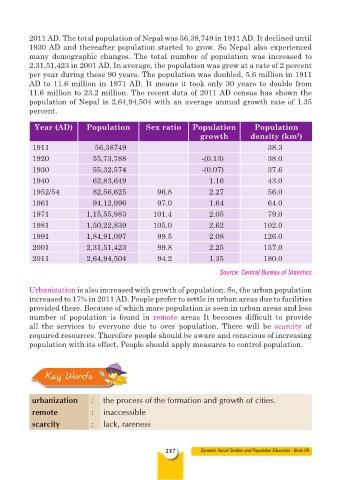
2011 AD. The total population of Nepal was 56,38,749 in 1911 AD. It declined until
          1930 AD and thereafter population started to grow. So Nepal also experienced
          many demographic changes.  The total number of population was increased to
          2,31,51,423 in 2001 AD. In average, the population was grew at a rate of 2 percent
          per year during these 90 years. The population was doubled, 5.6 million in 1911
          AD to 11.6 million in 1971 AD. It means it took only 30 years to double from
          11.6 million to 23.2 million. The recent data of 2011 AD census has shown the
          population of Nepal is 2,64,94,504 with an average annual growth rate of 1.35
          percent.
           Year (AD)      Population       Sex ratio     Population        Population
                                                           growth         density (km )
                                                                                       2
          1911               56,38749                                          38.3
          1920              55,73,788                       -(0.13)            38.0
          1930              55,32,574                       -(0.07)            37.6
          1940              62,83,649                         1.16             43.0
          1952/54           82,56,625          96.8           2.27             56.0
          1961              94,12,996          97.0           1.64             64.0
          1971            1,15,55,983         101.4           2.05             79.0
          1981            1,50,22,839         105.0           2.62            102.0
          1991            1,84,91,097          99.5           2.08            126.0
          2001            2,31,51,423          99.8           2.25            157.0
          2011            2,64,94,504          94.2           1.35            180.0

                                                                 Source: Central Bureau of Statistics

          Urbanization is also increased with growth of population. So, the urban population
          increased to 17% in 2011 AD. People prefer to settle in urban areas due to facilities
          provided there. Because of which more population is seen in urban areas and less
          number of population is found in  remote  areas  It  becomes  difficult  to  provide
          all the services to everyone due to over population. There will be  scarcity of
          required resources. Therefore people should be aware and conscious of increasing
          population with its effect. People should apply measures to control population.


              Key Words


          urbanization      :  the process of the formation and growth of cities.
          remote            :  inaccessible
          scarcity          :  lack, rareness


                                                 217       Dynamic Social Studies and Population Education - Book VII

