


Page 223 - Social Studies 7
P. 223
6.7 percent of total population is living in the Himalayan region. The Hilly region
          having plain valleys, hills,  basins,  tars, etc. population here is comparatively
          more than the Himalayan region  but less  than the Terai region.  According  to
          the census BS 2068  the total population living in hilly region is 43 percent. It
          has moderate climate and land is fertile in valleys, tars, basins, so agriculture is
          practiced as a main occupation. Moreover, capital city Kathmandu is located with
          this reason. The Terai region have plain land, fertile soil, good irrigation facilities
          with  very  good infrastructures  of  development as  compared to  other  regions.
          Therefore, it has high density of population. The data shows that 50.3 percent of
          total population live in the Terai region. It has suitable climate for agriculture.
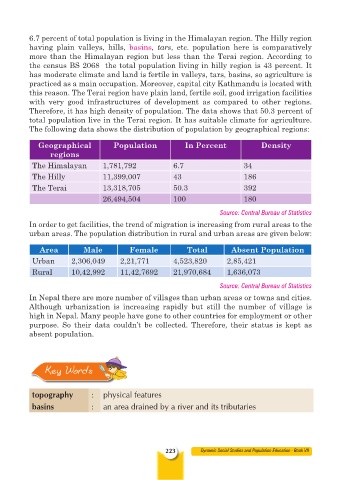
          The following data shows the distribution of population by geographical regions:
            Geographical          Population           In Percent            Density
                regions
          The Himalayan        1,781,792           6.7                  34

          The Hilly            11,399,007          43                   186
          The Terai            13,318,705          50.3                 392
                               26,494,504          100                  180
                                                                 Source: Central Bureau of Statistics
          In order to get facilities, the trend of migration is increasing from rural areas to the
          urban areas. The population distribution in rural and urban areas are given below:
             Area        Male          Female          Total        Absent Population

          Urban       2,306,049     2,21,771       4,523,820       2,85,421
          Rural       10,42,992     11,42,7692     21,970,684      1,636,073
                                                                 Source: Central Bureau of Statistics
          In Nepal there are more number of villages than urban areas or towns and cities.
          Although  urbanization  is  increasing  rapidly but still  the  number  of  village is
          high in Nepal. Many people have gone to other countries for employment or other
          purpose.  So  their  data couldn’t  be  collected.  Therefore,  their  status  is  kept  as
          absent population.


              Key Words


          topography        :  physical features
          basins            :  an area drained by a river and its tributaries


                                                 223       Dynamic Social Studies and Population Education - Book VII

