


Page 55 - Social Studies 7
P. 55
Lesson      Some Historical Personalities of
         2.5

                     Our Country


                                       Mangala Devi Singh was a pioneer feminist and
                           FACTS       prominent democratic right activist of Nepal. She spent
                        to Understand  many years in jail. She was the founder of Nepal Women
                                       Association and the wife of leading Nepali  Congress
                                       leader Ganesh Man Singh.


          Nepal has given birth to many personalities. Many people contributed a lot to the
          welfare of the nation. They worked hard for the society and the country. Those
          personalities who made remarkable contribution in the past to enhance the glory
          of the nation, are called historical personalities of the country. Many personalities
          in the history of Nepal contributed to bring reformation and welfare of the country.
          Some of the personalities and their contributions are given below:

              The four Great Martyrs                       Contributions
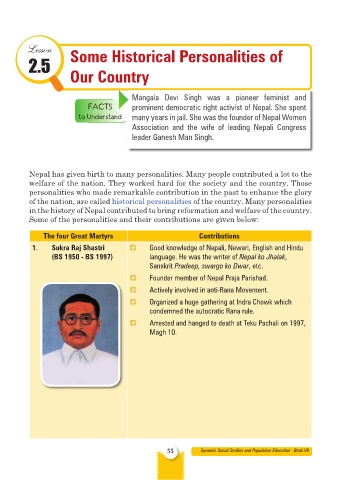
          1.    Sukra Raj Shastri            Good knowledge of Nepali, Newari, English and Hindu
                (BS 1950 - BS 1997)          language. He was the writer of Nepal ko Jhalak,
                                             Sanskrit Pradeep, swargo ko Dwar, etc.

                                             Founder member of Nepal Praja Parishad.
                                             Actively involved in anti-Rana Movement.
                                             Organized a huge gathering at Indra Chowk which
                                             condemned the autocratic Rana rule.
                                             Arrested and hanged to death at Teku Pachali on 1997,
                                             Magh 10.


                                                  55       Dynamic Social Studies and Population Education - Book VII

