


Page 52 - Office Practice and Accounting 10
P. 52
they are encashed; they thus perform the same function as money. Normally, three
          types of cheque like Bearer Cheque, Order Cheque and Crossed Cheque are used to
          settle the financial liabilities.

          A legal definition of cheque- ‘’A cheque is an unconditional order, drawn upon a
          specified banker, signed by the maker, directing the banker to pay on demand a certain
          sum of money only to or to the order of a person or to the bearer of the instrument.’’
          According to it , the following are the essentials of a cheque :

          -     It is an unconditional order.
          -     It must be drawn upon a specified banker.
          -     It must be signed by the maker.
          -     The amount must be payable on demand.
          -     It is payable either to bearer or ordered.

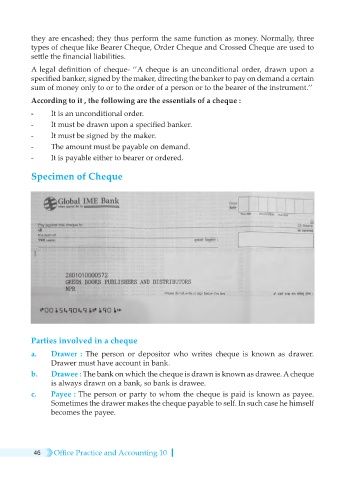
          Specimen of Cheque


          Parties involved in a cheque
          a.    Drawer  :  The  person  or  depositor  who  writes  cheque  is  known  as  drawer.
                Drawer must have account in bank.
          b.    Drawee : The bank on which the cheque is drawn is known as drawee. A cheque
                is always drawn on a bank, so bank is drawee.
          c.    Payee : The person or party to whom the cheque is paid is known as payee.
                Sometimes the drawer makes the cheque payable to self. In such case he himself
                becomes the payee.


           46    Office Practice and Accounting 10

