


Page 99 - Hello-Grammar-Book-7
P. 99
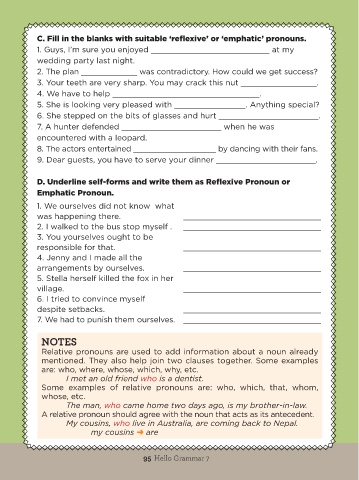
C. Fill in the blanks with suitable ‘reflexive’ or ‘emphatic’ pronouns.
            1. Guys, I’m sure you enjoyed _________________________ at my
            wedding party last night.
            2. The plan ____________ was contradictory. How could we get success?
            3. Your teeth are very sharp. You may crack this nut ________________.
            4. We have to help _______________________________.
            5. She is looking very pleased with _______________. Anything special?
            6. She stepped on the bits of glasses and hurt _____________________.
            7. A hunter defended _____________________ when he was
            encountered with a leopard.
            8. The actors entertained __________________ by dancing with their fans.
            9. Dear guests, you have to serve your dinner _____________________.


            D. Underline self-forms and write them as Reflexive Pronoun or
            Emphatic Pronoun.

            1. We ourselves did not know  what
            was happening there.                      _____________________________
            2. I walked to the bus stop myself .      _____________________________
            3. You yourselves ought to be
            responsible for that.                     _____________________________
            4. Jenny and I made all the
            arrangements by ourselves.                _____________________________
            5. Stella herself killed the fox in her
            village.                                  _____________________________
            6. I tried to convince myself
            despite setbacks.                         _____________________________
            7. We had to punish them ourselves.  _____________________________

             NOTES
             Relative pronouns are used to add information about a noun already
             mentioned. They also help join two clauses together. Some examples
             are: who, where, whose, which, why, etc.
                    I met an old friend who is a dentist.
             Some examples of relative pronouns are: who, which, that, whom,
             whose, etc.
                    The man, who came home two days ago, is my brother-in-law.
             A relative pronoun should agree with the noun that acts as its antecedent.
                    My cousins, who live in Australia, are coming back to Nepal.
                           my cousins « are


                                           95  Hello Grammar 7

