


Page 155 - Health, Population and Environment Education 10
P. 155
Nature or         •  Acute diseases (Short-term   •  Chronic or long term
             characteristics of    disease) Examples: Cholera,     diseases
             disease               common cold, diarrhoea,     •  Can be prevented easily but
                                   dsentery, typhoid, etc.         difficult to cure

                               •  Life-threatening and
                                   incurable diseases
                                   Examples: AIDS, Hepatitis
                                   B, etc.


             7.11  Some non-communicable Diseases


            A.  Cancer
            Cancer is a non-communicable disease. It is a group of diseases involving abnormal cell
            growth with the potential to spread or invade to other parts of the body. Cancer may
            occur in any organ of the body.

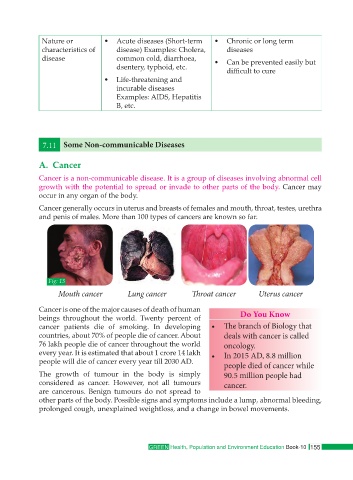
            Cancer generally occurs in uterus and breasts of females and mouth, throat, testes, urethra
            and penis of males. More than 100 types of cancers are known so far.


               Fig: 13
                  Mouth cancer        Lung cancer        Throat cancer      Uterus cancer

            Cancer is one of the major causes of death of human        Do You Know
            beings throughout the world. Twenty percent of
            cancer patients die of smoking. In developing      •  The branch of Biology that
            countries, about 70% of people die of cancer. About   deals with cancer is called
            76 lakh people die of cancer throughout the world     oncology.
            every year. It is estimated that about 1 crore 14 lakh   •  In 2015 AD, 8.8 million
            people will die of cancer every year till 2030 AD.
                                                                  people died of cancer while
            The growth of tumour in the body is simply            90.5 million people had
            considered  as cancer. However,  not all tumours      cancer.
            are cancerous.  Benign tumours  do  not spread to
            other parts of the body. Possible signs and symptoms include a lump, abnormal bleeding,
            prolonged cough, unexplained weightloss, and a change in bowel movements.


                                            GREEN  Health, Population and Environment Education Book-10 155

