


Page 191 - Health, Population and Environment Education 10
P. 191
In Nepal, there are legal conditions  under which abortion service can be obtained.
            Abortion is legal in Nepal on the following conditions:
            i.   Upto 12 weeks of gestation for any woman
            ii.  Upto 18 weeks of gestation if the pregnancy results from rape or incest, and
            iii.  At any time during pregnancy with the advice of a medical practitioner or if the
                physical or mental health or life of the pregnant woman is at risk or if the foetus is
                deformed and incompatible with life.

            Abortion is punishable under the following conditions:
            i.   Sex selective abortion and
            ii.  Abortion without the consent of the pregnant  woman.


              8.3  Maternal and Child Health Care and its Measures
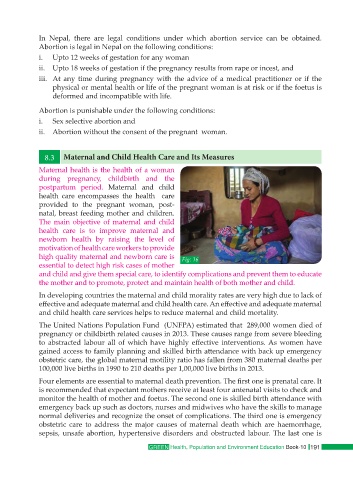
            Maternal health is the health of a woman
            during pregnancy, childbirth and the
            postpartum  period. Maternal  and  child
            health care encompasses the health  care
            provided to the pregnant woman, post-
            natal, breast feeding mother and children.
            The main objective of maternal and child
            health care is to improve maternal and
            newborn health by raising the level of
            motivation of health care workers to provide
            high quality maternal and newborn care is   Fig: 16
            essential to detect high risk cases of mother
            and child and give them special care, to identify complications and prevent them to educate
            the mother and to promote, protect and maintain health of both mother and child.

            In developing countries the maternal and child morality rates are very high due to lack of
            effective and adequate maternal and child health care. An effective and adequate maternal
            and child health care services helps to reduce maternal and child mortality.
            The United Nations Population Fund  (UNFPA) estimated that  289,000 women died of
            pregnancy or childbirth related causes in 2013. These causes range from severe bleeding
            to abstracted labour all of which have highly effective interventions. As women have
            gained access to family planning and skilled birth attendance with back up emergency
            obstetric care, the global maternal motility ratio has fallen from 380 maternal deaths per
            100,000 live births in 1990 to 210 deaths per 1,00,000 live births in 2013.
            Four elements are essential to maternal death prevention. The first one is prenatal care. It
            is recommended that expectant mothers receive at least four antenatal visits to check and
            monitor the health of mother and foetus. The second one is skilled birth attendance with
            emergency back up such as doctors, nurses and midwives who have the skills to manage
            normal deliveries and recognize the onset of complications. The third one is emergency
            obstetric care to address  the major  causes  of maternal death which are haemorrhage,
            sepsis,  unsafe abortion, hypertensive disorders  and obstructed labour. The last one is
                                            GREEN  Health, Population and Environment Education Book-10 191

