


Page 199 - Health, Population and Environment Education 10
P. 199
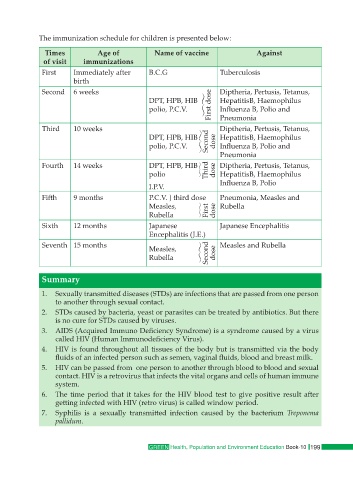
The immunization schedule for children is presented below:

              Times          Age of           Name of vaccine               Against
              of visit   immunizations
             First    Immediately after     B.C.G                Tuberculosis
                      birth
             Second   6 weeks                                    Diptheria, Pertusis, Tetanus,
                                            DPT, HPB, HIB        HepatitisB, Haemophilus
                                            polio, P.C.V.     First dose  Influenza B, Polio and
                                                                 Pneumonia
             Third    10 weeks                                   Diptheria, Pertusis, Tetanus,
                                            DPT, HPB, HIB    Second   HepatitisB, Haemophilus
                                            polio, P.C.V.       dose  Influenza B, Polio and
                                                                 Pneumonia
             Fourth   14 weeks              DPT, HPB, HIB        Diptheria, Pertusis, Tetanus,
                                            polio            Third   dose  HepatitisB, Haemophilus
                                            I.P.V.               Influenza B, Polio
             Fifth    9 months              P.C.V. } third dose   Pneumonia, Measles and
                                            Measles,             Rubella
                                            Rubella          First   dose
             Sixth    12 months             Japanese             Japanese Encephalitis
                                            Encephalitis (J.E.)
             Seventh 15 months              Measles,             Measles and Rubella
                                            Rubella          Second   dose


             Summary
             1.  Sexually transmitted diseases (STDs) are infections that are passed from one person
                 to another through sexual contact.
             2.  STDs caused by bacteria, yeast or parasites can be treated by antibiotics. But there
                 is no cure for STDs caused by viruses.
             3.  AIDS (Acquired Immuno Deficiency Syndrome) is a syndrome caused by a virus
                 called HIV (Human Immunodeficiency Virus).
             4.  HIV is found throughout all tissues of the body but is transmitted via the body
                 fluids of an infected person such as semen, vaginal fluids, blood and breast milk.
             5.  HIV can be passed from  one person to another through blood to blood and sexual
                 contact. HIV is a retrovirus that infects the vital organs and cells of human immune
                 system.
             6.  The time period that it takes for the HIV blood test to give positive result after
                 getting infected with HIV (retro virus) is called window period.
             7.  Syphilis  is  a  sexually  transmitted  infection  caused  by  the  bacterium  Treponema
                 pallidum.


                                            GREEN  Health, Population and Environment Education Book-10 199

