


Page 72 - Grammar- 10
P. 72
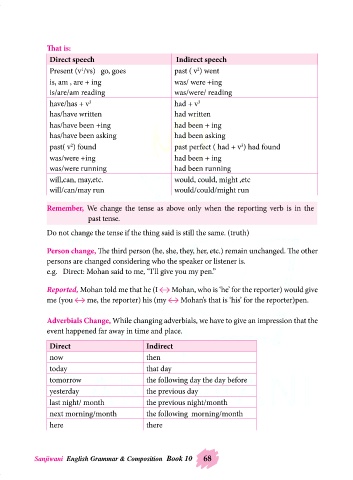
That is:
                  Direct speech                                  Indirect speech
                  Present (v /vs)   go, goes           past ( v ) went
                            1
                                                             2
                  is, am , are + ing                   was/ were +ing
                  is/are/am reading                    was/were/ reading
                  have/has + v 3                       had + v 3
                  has/have written                     had written
                  has/have been +ing                   had been + ing
                  has/have been asking                 had been asking
                  past( v ) found                      past perfect ( had + v ) had found
                                                                          3
                         2
                  was/were +ing                        had been + ing
                  was/were running                     had been running
                  will,can, may,etc.                   would, could, might ,etc
                  will/can/may run                     would/could/might run


                  Remember, We change the tense as above only when the reporting verb is in the
                              past tense.
                  Do not change the tense if the thing said is still the same. (truth)

                  Person change, The third person (he, she, they, her, etc.) remain unchanged. The other
                  persons are changed considering who the speaker or listener is.
                  e.g.   Direct: Mohan said to me, “I’ll give you my pen.”


                  Reported, Mohan told me that he (I    Mohan, who is ‘he’ for the reporter) would give
                  me (you     me, the reporter) his (my    Mohan’s that is ‘his’ for the reporter)pen.


                  Adverbials Change, While changing adverbials, we have to give an impression that the
                  event happened far away in time and place.

                  Direct                       Indirect
                  now                          then
                  today                                       that day
                  tomorrow                     the following day the day before
                  yesterday                    the previous day
                  last night/ month            the previous night/month
                  next morning/month           the following  morning/month
                  here                                                       there


              Sanjiwani  English Grammar & Composition  Book 10  68

