


Page 114 - Office Practice and Accounting -9
P. 114
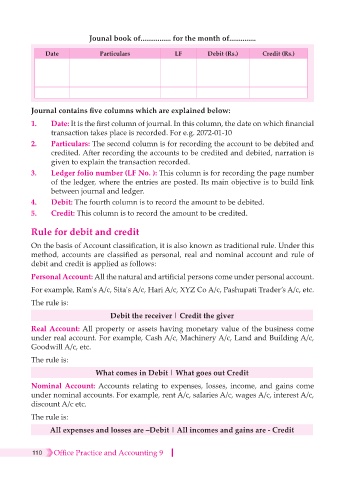
Jounal book of................ for the month of..............

              Date            Particulars           LF       Debit (Rs.)     Credit (Rs.)


          Journal contains five columns which are explained below:

          1.    Date: It is the first column of journal. In this column, the date on which financial
                transaction takes place is recorded. For e.g. 2072-01-10
          2.    Particulars: The second column is for recording the account to be debited and
                credited. After recording the accounts to be credited and debited, narration is
                given to explain the transaction recorded.
          3.    Ledger folio number (LF No. ): This column is for recording the page number
                of the ledger, where the entries are posted. Its main objective is to build link
                between journal and ledger.
          4.    Debit: The fourth column is to record the amount to be debited.
          5.    Credit: This column is to record the amount to be credited.

          Rule for debit and credit

          On the basis of Account classification, it is also known as traditional rule. Under this
          method, accounts are classified as personal, real and nominal account and rule of
          debit and credit is applied as follows:
          Personal Account: All the natural and artificial persons come under personal account.

          For example, Ram's A/c, Sita's A/c, Hari A/c, XYZ Co A/c, Pashupati Trader’s A/c, etc.
          The rule is:
                                 Debit the receiver | Credit the giver

          Real Account: All property or assets having monetary value of the business come
          under real account. For example, Cash A/c, Machinery A/c, Land and Building A/c,
          Goodwill A/c, etc.
          The rule is:

                             What comes in Debit | What goes out Credit
          Nominal Account: Accounts relating to expenses, losses, income, and gains come
          under nominal accounts. For example, rent A/c, salaries A/c, wages A/c, interest A/c,
          discount A/c etc.

          The rule is:
                All expenses and losses are –Debit | All incomes and gains are - Credit


          110    Office Practice and Accounting 9

