


Page 143 - Office Practice and Accounting -9
P. 143
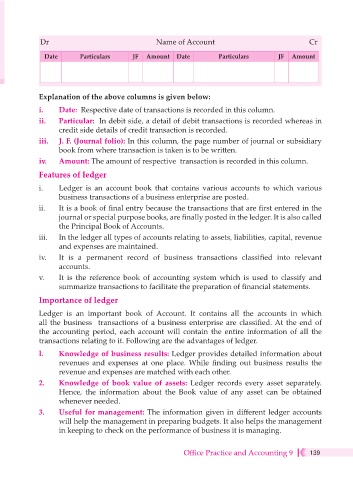
Dr                               Name of Account                              Cr

              Date      Particulars     JF  Amount  Date         Particulars      JF  Amount


            Explanation of the above columns is given below:
            i.    Date:  Respective date of transactions is recorded in this column.
            ii.   Particular:  In debit side, a detail of debit transactions is recorded whereas in
                  credit side details of credit transaction is recorded.
            iii.   J. F. (Journal folio): In this column, the page number of journal or subsidiary
                  book from where transaction is taken is to be written.
            iv.   Amount: The amount of respective  transaction is recorded in this column.

            Features of ledger
            i.    Ledger  is  an  account  book  that  contains  various  accounts  to  which  various
                  business transactions of a business enterprise are posted.
            ii.   It is a book of final entry because the transactions that are first entered in the
                  journal or special purpose books, are finally posted in the ledger. It is also called
                  the Principal Book of Accounts.
            iii.   In the ledger all types of accounts relating to assets, liabilities, capital, revenue
                  and expenses are maintained.
            iv.   It  is  a  permanent  record  of  business  transactions  classified  into  relevant
                  accounts.
            v.    It  is  the  reference  book  of  accounting  system  which  is  used  to  classify  and
                  summarize transactions to facilitate the preparation of financial statements.
            Importance of ledger

            Ledger  is  an  important  book  of  Account.  It  contains  all  the  accounts  in  which
            all the business  transactions of a business enterprise are classified. At the end of
            the  accounting  period,  each  account  will  contain  the  entire  information  of  all  the
            transactions relating to it. Following are the advantages of ledger.
            l.    Knowledge of business results: Ledger provides detailed information about
                  revenues  and  expenses  at  one  place.  While  finding  out  business  results  the
                  revenue and expenses are matched with each other.
            2.    Knowledge  of  book  value  of  assets:  Ledger  records  every  asset  separately.
                  Hence,  the  information  about  the  Book  value  of  any  asset  can  be  obtained
                  whenever needed.
            3.    Useful for management: The information given in different ledger accounts
                  will help the management in preparing budgets. It also helps the management
                  in keeping to check on the performance of business it is managing.


                                                      Office Practice and Accounting 9     139

