


Page 27 - CLINICAL PRACTICE II
P. 27
CikguOnline
   CikguOnline

                                                                                                     Appendix 1

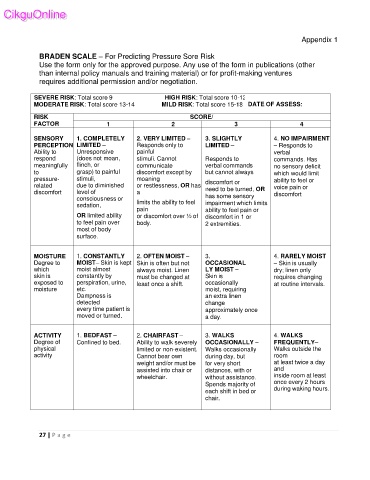
              BRADEN SCALE – For Predicting Pressure Sore Risk
              Use the form only for the approved purpose. Any use of the form in publications (other
              than internal policy manuals and training material) or for profit-making ventures
              requires additional permission and/or negotiation.

             SEVERE RISK: Total score 9                              HIGH RISK: Total score 10-12
            MODERATE RISK: Total score 13-14                  MILD RISK: Total score 15-18  DATE OF ASSESS:

            RISK                                                SCORE/
            FACTOR                  1                     2   DESCRIPTION      3                    4

            SENSORY       1. COMPLETELY       2. VERY LIMITED –      3. SLIGHTLY            4. NO IMPAIRMENT
            PERCEPTION  LIMITED –             Responds only to       LIMITED –              – Responds to
            Ability to    Unresponsive        painful                                       verbal
            respond       (does not moan,     stimuli. Cannot        Responds to            commands. Has
            meaningfully   flinch, or         communicate            verbal commands        no sensory deficit
            to            grasp) to painful   discomfort except by   but cannot always      which would limit
            pressure-     stimuli,            moaning                  discomfort or        ability to feel or
            related       due to diminished   or restlessness, OR has   need to be turned, OR   voice pain or
            discomfort    level of            a                                             discomfort
                          consciousness or      limits the ability to feel   has some sensory
                          sedation,                                  impairment which limits
                                              pain                   ability to feel pain or
                          OR limited ability   or discomfort over ½ of  discomfort in 1 or
                          to feel pain over   body.                  2 extremities.
                          most of body
                          surface.


            MOISTURE      1. CONSTANTLY       2. OFTEN MOIST –       3.                     4. RARELY MOIST
            Degree to     MOIST– Skin is kept  Skin is often but not   OCCASIONAL           – Skin is usually
            which         moist almost        always moist. Linen    LY MOIST –             dry; linen only
            skin is       constantly by       must be changed at     Skin is                requires changing
            exposed to    perspiration, urine,   least once a shift.   occasionally         at routine intervals.
            moisture      etc.                                       moist, requiring
                          Dampness is                                an extra linen
                          detected                                   change
                          every time patient is                      approximately once
                          moved or turned.                           a day.


            ACTIVITY      1. BEDFAST –        2. CHAIRFAST –         3. WALKS               4. WALKS
            Degree of     Confined to bed.    Ability to walk severely   OCCASIONALLY –     FREQUENTLY–
            physical                          limited or non-existent.   Walks occasionally   Walks outside the
            activity                          Cannot bear own        during day, but        room
                                              weight and/or must be   for very short        at least twice a day
                                              assisted into chair or   distances, with or   and

                                              wheelchair.            without assistance.    inside room at least
                                                                     Spends majority of     once every 2 hours
                                                                                            during waking hours.
                                                                     each shift in bed or
                                                                     chair.


              27 | P a g e

