


Page 265 - leadership-experience-2008
P. 265
CikguOnline
      CikguOnline
            246                                                               PART 4: THE LEADER AS A RELATIONSHIP BUILDER

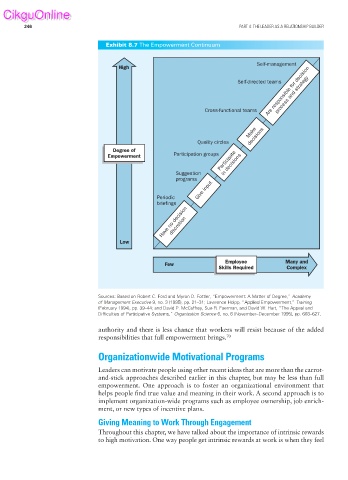
                                     Exhibit 8.7 The Empowerment Continuum


                                                                                    Self-management
                                         High
                                                                                       Are responsible for decision
                                                                                          process and strategy
                                                                              Self-directed teams


                                                                    Cross-functional teams

                                                                                 Make
                                                                                  decisions
                                                                  Quality circles
                                        Degree of
                                                                         Participate
                                                          Participation groups
                                                                          in decisions
                                      Empowerment
                                                           Suggestion
                                                           programs
                                                                  Give input
                                                     Periodic
                                                     briefings
                                                      Have no decision
                                                          discretion


                                          Low


                                                                          Employee           Many and
                                                       Few
                                                                        Skills Required      Complex


                                   Sources: Based on Robert C. Ford and Myron D. Fottler, “Empowerment: A Matter of Degree,” Academy
                                   of Management Executive 9, no. 3 (1995), pp. 21–31; Lawrence Holpp, “Applied Empowerment,” Training
                                   (February 1994), pp. 39–44; and David P. McCaffrey, Sue R. Faerman, and David W. Hart, “The Appeal and
                                   Difficulties of Participative Systems,” Organization Science 6, no. 6 (November–December 1995), pp. 603–627.

                                   authority and there is less chance that workers will resist because of the added
                                   responsibilities that full empowerment brings. 70


                                   Organizationwide Motivational Programs

                                   Leaders can motivate people using other recent ideas that are more than the carrot-
                                   and-stick approaches described earlier in this chapter, but may be less than full
                                   empowerment. One approach is to foster an organizational environment that

                                   helps people find true value and meaning in their work. A second approach is to
                                   implement organization-wide programs such as employee ownership, job enrich-
                                   ment, or new types of incentive plans.

                                   Giving Meaning to Work Through Engagement
                                   Throughout this chapter, we have talked about the importance of intrinsic rewards
                                   to high motivation. One way people get intrinsic rewards at work is when they feel

