


Page 408 - leadership-experience-2008
P. 408
CikguOnline
         CikguOnline
               CHAPTER 13: CREATING VISION AND STRATEGIC DIRECTION                                       389

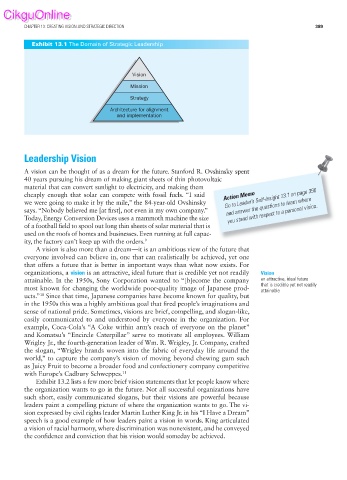
                  Exhibit 13.1 The Domain of Strategic Leadership


                                                 Vision
                                                Mission
                                                Strategy

                                          Architecture for alignment
                                            and implementation


               Leadership Vision
               A vision can be thought of as a dream for the future. Stanford R. Ovshinsky spent
               40 years pursuing his dream of making giant sheets of thin photovoltaic
               material that can convert sunlight to electricity, and making them
                                                                             Go to Leader’s Self-Insight 13.1 on page 390
               cheaply enough that solar can compete with fossil fuels. “I said   Action Memo
               we were going to make it by the mile,” the 84-year-old Ovshinsky   and answer the questions to learn where
               says. “Nobody believed me [at fi rst], not even in my own company.”   you stand with respect to a personal vision.
               Today, Energy Conversion Devices uses a mammoth machine the size

               of a football field to spool out long thin sheets of solar material that is
               used on the roofs of homes and businesses. Even running at full capac-
               ity, the factory can’t keep up with the orders. 9
                   A vision is also more than a dream—it is an ambitious view of the future that
               everyone involved can believe in, one that can realistically be achieved, yet one
               that offers a future that is better in important ways than what now exists. For
               organizations, a vision is an attractive, ideal future that is credible yet not readily   Vision
                                                                                        Vision
                                                                                        an attractive, ideal future
               attainable. In the 1950s, Sony Corporation wanted to “[b]ecome the company   an attractive, ideal future
                                                                                        that is credible yet not readily
                                                                                        that is credible yet not readily
               most known for changing the worldwide poor-quality image of Japanese prod-
                                                                                        attainable
                                                                                        attainable
               ucts.”  Since that time, Japanese companies have become known for quality, but
                    10

               in the 1950s this was a highly ambitious goal that fired people’s imaginations and
               sense of national pride. Sometimes, visions are brief, compelling, and slogan-like,
               easily communicated to and understood by everyone in the organization. For
               example, Coca-Cola’s “A Coke within arm’s reach of everyone on the planet”
               and Komatsu’s “Encircle Caterpillar” serve to motivate all employees. William
               Wrigley Jr., the fourth-generation leader of Wm. R. Wrigley, Jr. Company, crafted
               the slogan, “Wrigley brands woven into the fabric of everyday life around the
               world,” to capture the company’s vision of moving beyond chewing gum such
               as Juicy Fruit to become a broader food and confectionery company competitive
               with Europe’s Cadbury Schweppes. 11
                   Exhibit 13.2 lists a few more brief vision statements that let people know where
               the organization wants to go in the future. Not all successful organizations have
               such short, easily communicated slogans, but their visions are powerful  because
               leaders paint a compelling picture of where the organization wants to go. The vi-
               sion expressed by civil rights leader Martin Luther King Jr. in his “I Have a Dream”
               speech is a good example of how leaders paint a vision in words. King articulated
               a vision of racial harmony, where discrimination was nonexistent, and he conveyed
               the confi dence and conviction that his vision would someday be achieved.

