


Page 489 - leadership-experience-2008
P. 489
CikguOnline
      CikguOnline
            470                                                                   PART 5: THE LEADER AS SOCIAL ARCHITECT
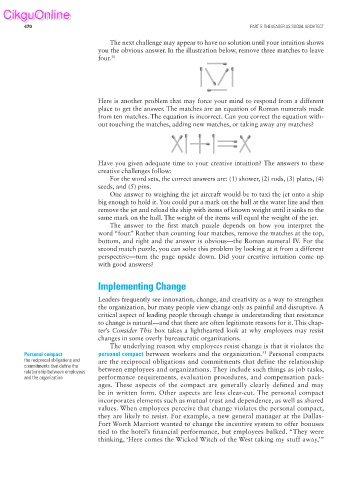
                                       The next challenge may appear to have no solution until your intuition shows
                                   you the obvious answer. In the illustration below, remove three matches to leave
                                   four. 50


                                   Here is another problem that may force your mind to respond from a different
                                   place to get the answer. The matches are an equation of Roman numerals made
                                   from ten matches. The equation is incorrect. Can you correct the equation with-
                                   out touching the matches, adding new matches, or taking away any matches?


                                   Have you given adequate time to your creative intuition? The answers to these
                                   creative challenges follow:
                                       For the word sets, the correct answers are: (1) shower, (2) rods, (3) plates, (4)
                                   seeds, and (5) pins.
                                       One answer to weighing the jet aircraft would be to taxi the jet onto a ship
                                   big enough to hold it. You could put a mark on the hull at the water line and then
                                   remove the jet and reload the ship with items of known weight until it sinks to the
                                   same mark on the hull. The weight of the items will equal the weight of the jet.
                                       The answer to the first match puzzle depends on how you interpret the

                                   word “four.” Rather than counting four matches, remove the matches at the top,
                                     bottom, and right and the answer is obvious—the Roman numeral IV. For the
                                   second match puzzle, you can solve this problem by looking at it from a different
                                   perspective—turn the page upside down. Did your creative intuition come up
                                   with good answers?


                                   Implementing Change

                                   Leaders frequently see innovation, change, and creativity as a way to strengthen
                                   the organization, but many people view change only as painful and disruptive. A
                                   critical aspect of leading people through change is understanding that resistance
                                   to change is natural—and that there are often legitimate reasons for it. This chap-
                                   ter’s Consider This box takes a lighthearted look at why employees may resist
                                   changes in some overly bureaucratic organizations.
                                       The underlying reason why employees resist change is that it violates the
                                                                                      51
            Personal compact       personal compact between workers and the organization.  Personal compacts
            Personal compact
            the reciprocal obligations and   are the reciprocal obligations and commitments that define the relationship
            the reciprocal obligations and
            commitments that defi ne the
            commitments that defi ne the
            relationship between employees
            relationship between employees   between employees and organizations. They include such things as job tasks,
            and the organization
            and the organization   performance requirements, evaluation procedures, and compensation pack-
                                   ages.  These aspects of the compact are generally clearly defined and may
                                   be in written form. Other aspects are less clear-cut. The personal compact
                                   incorporates elements such as mutual trust and dependence, as well as shared
                                   values. When employees perceive that change violates the personal compact,
                                   they are likely to resist. For example, a new general manager at the Dallas-
                                   Fort Worth Marriott wanted to change the incentive system to offer bonuses
                                   tied to the hotel’s financial performance, but employees balked. “They were
                                   thinking, ‘Here comes the Wicked Witch of the West taking my stuff away,’”

