


Page 100 - policy and procedure infection control
P. 100
Policies and Procedures on Infection Control
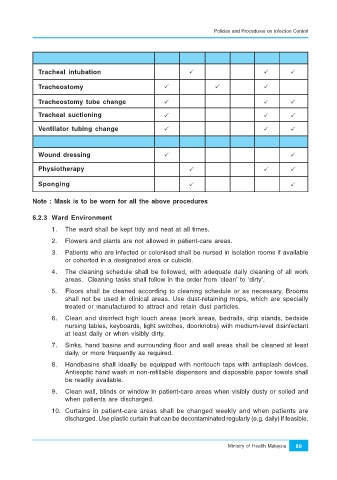
Respiratory care
Tracheal intubation
Tracheostomy
Tracheostomy tube change
Tracheal suctioning
Ventilator tubing change
Others
Wound dressing
Physiotherapy
Sponging
Note : Mask is to be worn for all the above procedures
6.2.3 Ward Environment
1. The ward shall be kept tidy and neat at all times.
2. Flowers and plants are not allowed in patient-care areas.
3. Patients who are infected or colonised shall be nursed in isolation rooms if available
or cohorted in a designated area or cubicle.
4. The cleaning schedule shall be followed, with adequate daily cleaning of all work
areas. Cleaning tasks shall follow in the order from ‘clean’ to ‘dirty’.
5. Floors shall be cleaned according to cleaning schedule or as necessary. Brooms
shall not be used in clinical areas. Use dust-retaining mops, which are specially
treated or manufactured to attract and retain dust particles.
6. Clean and disinfect high touch areas (work areas, bedrails, drip stands, bedside
nursing tables, keyboards, light switches, doorknobs) with medium-level disinfectant
at least daily or when visibly dirty.
7. Sinks, hand basins and surrounding floor and wall areas shall be cleaned at least
daily, or more frequently as required.
8. Handbasins shall ideally be equipped with nontouch taps with antisplash devices.
Antiseptic hand wash in non-refillable dispensers and disposable paper towels shall
be readily available.
9. Clean wall, blinds or window in patient-care areas when visibly dusty or soiled and
when patients are discharged.
10. Curtains in patient-care areas shall be changed weekly and when patients are
discharged. Use plastic curtain that can be decontaminated regularly (e.g. daily) if feasible.
Ministry of Health Malaysia 89

