


Page 143 - policy and procedure infection control
P. 143
Policies and Procedures on Infection Control


                 6.10       Laboratory


               6.10.1General Principles
                     In this topic, references are made to the relative hazards of infective microorganisms by
                     risk group (WHO Risk Groups 1, 2, 3 and 4). This risk group classification is to be used for
                     laboratory work only. This risk group classification is to be used for laboratory work only.
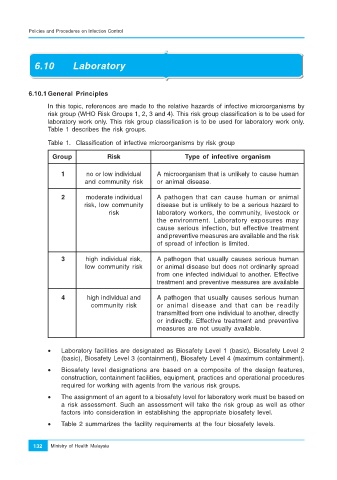
                     Table 1 describes the risk groups.
                     Table 1.  Classification of infective microorganisms by risk group

                      Group           Risk                   Type of  infective organism

                         1      no or low individual  A microorganism that is unlikely to cause human
                                and community risk   or animal disease.

                         2      moderate individual  A pathogen that can cause human or animal
                                risk, low community  disease but is unlikely to be a serious hazard to
                                       risk          laboratory workers, the community, livestock or
                                                     the environment. Laboratory exposures may
                                                     cause serious infection, but effective treatment
                                                     and preventive measures are available and the risk
                                                     of spread of infection is limited.

                         3      high individual risk,  A pathogen that usually causes serious human
                                low community risk   or animal disease but does not ordinarily spread
                                                     from one infected individual to another. Effective
                                                     treatment and preventive measures are available

                         4      high individual and  A pathogen that usually causes serious human
                                  community risk     or animal disease and that can be readily
                                                     transmitted from one individual to another, directly
                                                     or indirectly. Effective treatment and preventive
                                                     measures are not usually available.


                     •   Laboratory facilities are designated as Biosafety Level 1 (basic), Biosafety Level 2
                         (basic), Biosafety Level 3 (containment), Biosafety Level 4 (maximum containment).
                     •   Biosafety level designations are based on a composite of the design features,
                         construction, containment facilities, equipment, practices and operational procedures
                         required for working with agents from the various risk groups.
                     •   The assignment of an agent to a biosafety level for laboratory work must be based on
                         a risk assessment. Such an assessment will take the risk group as well as other
                         factors into consideration in establishing the appropriate biosafety level.
                     •   Table 2 summarizes the facility requirements at the four biosafety levels.


                 132  Ministry of Health Malaysia

