


Page 27 - policy and procedure infection control
P. 27
Policies and Procedures on Infection Control


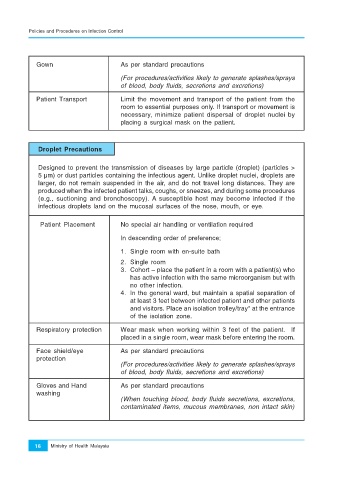
                 Gown                     As per standard precautions
                                          (For procedures/activities likely to generate splashes/sprays
                                          of blood, body fluids, secretions and excretions)
                 Patient Transport        Limit the movement and transport of the patient from the
                                          room to essential purposes only. If transport or movement is
                                          necessary, minimize patient dispersal of droplet nuclei by
                                          placing a surgical mask on the patient.


                  Droplet Precautions


                  Designed to prevent the transmission of diseases by large particle (droplet) (particles >
                  5 μm) or dust particles containing the infectious agent. Unlike droplet nuclei, droplets are
                  larger, do not remain suspended in the air, and do not travel long distances. They are
                  produced when the infected patient talks, coughs, or sneezes, and during some procedures
                  (e.g., suctioning and bronchoscopy). A susceptible host may become infected if the
                  infectious droplets land on the mucosal surfaces of the nose, mouth, or eye.

                   Patient Placement      No special air handling or ventilation required

                                          In descending order of preference;
                                          1. Single room with en-suite bath
                                          2. Single room
                                          3. Cohort – place the patient in a room with a patient(s) who
                                             has active infection with the same microorganism but with
                                             no other infection.
                                          4. In the general ward, but maintain a spatial separation of
                                             at least 3 feet between infected patient and other patients
                                             and visitors. Place an isolation trolley/tray* at the entrance
                                             of the isolation zone.

                 Respiratory protection   Wear mask when working within 3 feet of the patient.  If
                                          placed in a single room, wear mask before entering the room.

                 Face shield/eye          As per standard precautions
                 protection
                                          (For procedures/activities likely to generate splashes/sprays
                                          of blood, body fluids, secretions and excretions)
                 Gloves and Hand          As per standard precautions
                 washing
                                          (When touching blood, body fluids secretions, excretions,
                                          contaminated items, mucous membranes, non intact skin)


                 16   Ministry of Health Malaysia

